
Weighted Training Bats Explained: Why Where the Weight Sits Matters
Not all weighted bats teach the same swing. Here is how hand-loaded trainers, barrel-weighted bats, one-hand trainers and feedback bats differ, and how to build a routine with them.

Every weighted bat makes a hitter stronger. Not every weighted bat makes a hitter better. The difference is where the extra weight sits. Put it at the end of the barrel and the bat pulls the hands away from the body, which is the casting habit most coaches spend years trying to fix. Put it in the hands and the easiest swing to take becomes the short, connected one. This guide breaks training bats into four families, explains what each one teaches, and shows how to build a simple routine around them for baseball and softball hitters.
The short answer
- Hand-loaded trainers put the extra weight in or just above the hands. They build strength while teaching a compact path to the ball. Examples: the CamWood Hands & Speed Trainer and the ProNine IPTB Ideal Path.
- Barrel-weighted bats (donuts, sleeves and heavy game-shape bats) add load at the far end. They build strength, but they also reward a long, sweeping swing if they are overused.
- One-hand trainers are short bats that isolate the top hand and the bottom hand so each one learns its job.
- Feedback bats (sweet spot, flat and thin-barrel bats) are not about weight at all. They tell the hitter on every swing whether the ball was squared up.
Most hitters get the most out of a hand-loaded trainer for the path, a one-hand trainer for the hands, and a feedback bat for barrel accuracy. You do not need all of them on day one.
Barrel-weighted bats: strength, with a catch
The classic on-deck donut slides onto the barrel and makes the bat feel heavy at the end. Heavy game-shape bats work the same way. Swinging them builds forearm and core strength, and a few swings before an at-bat make the game bat feel light.
The catch is mechanical. Weight at the end of a long lever pulls the barrel away from the body as the swing starts. To get it moving, hitters tend to push the hands out early and sweep the barrel around, which is the long, loopy swing that leaves them late on velocity and weak on the inside pitch. Used for a handful of warm-up swings, that is a small price. Used for hundreds of practice reps, it can groove the wrong pattern.
A middle ground is a weighted bat that keeps game dimensions and spreads the extra weight along the bat. The ProNine FPWTB Fastpitch Weighted Training Bat ($99.95) is built that way for softball: a game-size barrel at roughly a -2 length-to-weight ratio, several ounces heavier than a fastpitch game bat, meant for tee and soft toss work.
Hand-loaded trainers: weight where the swing starts
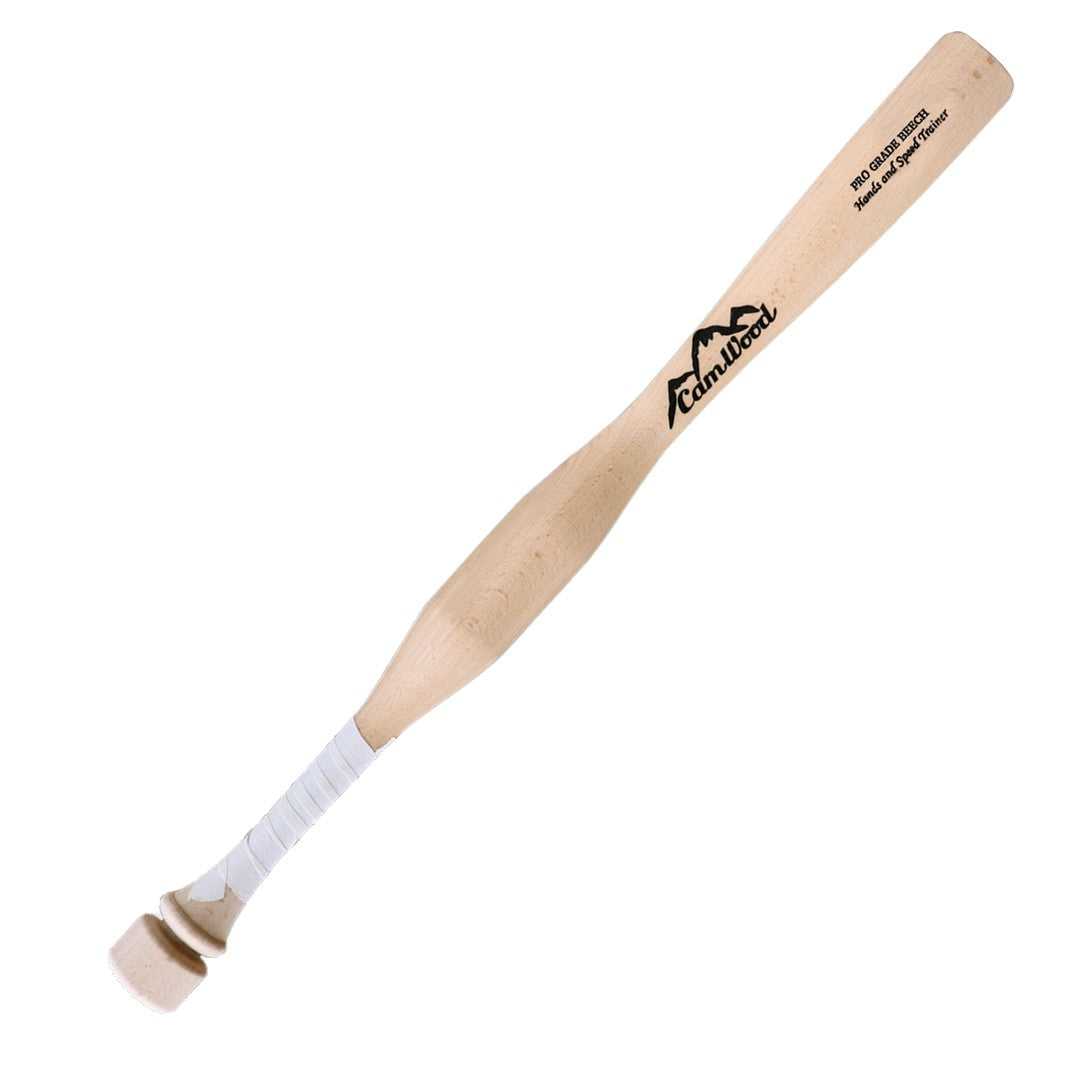
A hand-loaded trainer moves the extra mass to the handle, in and just above the hands, and often adds an extended knob to counterbalance it. The bat feels heavy in the hands but balanced overall. That changes what the body has to do to swing it. With the load close to the hands, the easiest move is to keep the hands inside the ball and let the knob lead toward contact. Casting feels clumsy, so hitters self-correct without a coach repeating the same cue on every rep.
The CamWood Baseball Hands & Speed Trainer ($109.95) is one well-known version of this idea. It is made from beech, comes in 26 to 34 inch lengths at 32 to 46 ounces, and is sized to match the player's game bat. There is a CamWood Softball Hands & Speed Trainer ($109.95) with softball sizing (32 to 40 ounces). The ProNine IPTB Ideal Path Training Bat ($99.95) uses the same weight-above-the-hands principle in birch bamboo and comes in youth and adult models, each in a one-hand and a two-hand version.
Hand-loaded trainers fit best into tee work, front toss and soft toss with real balls. They are a strong first trainer for a player who casts, gets long to the ball, or struggles to handle the inside pitch.
One-hand trainers: teach each hand its job
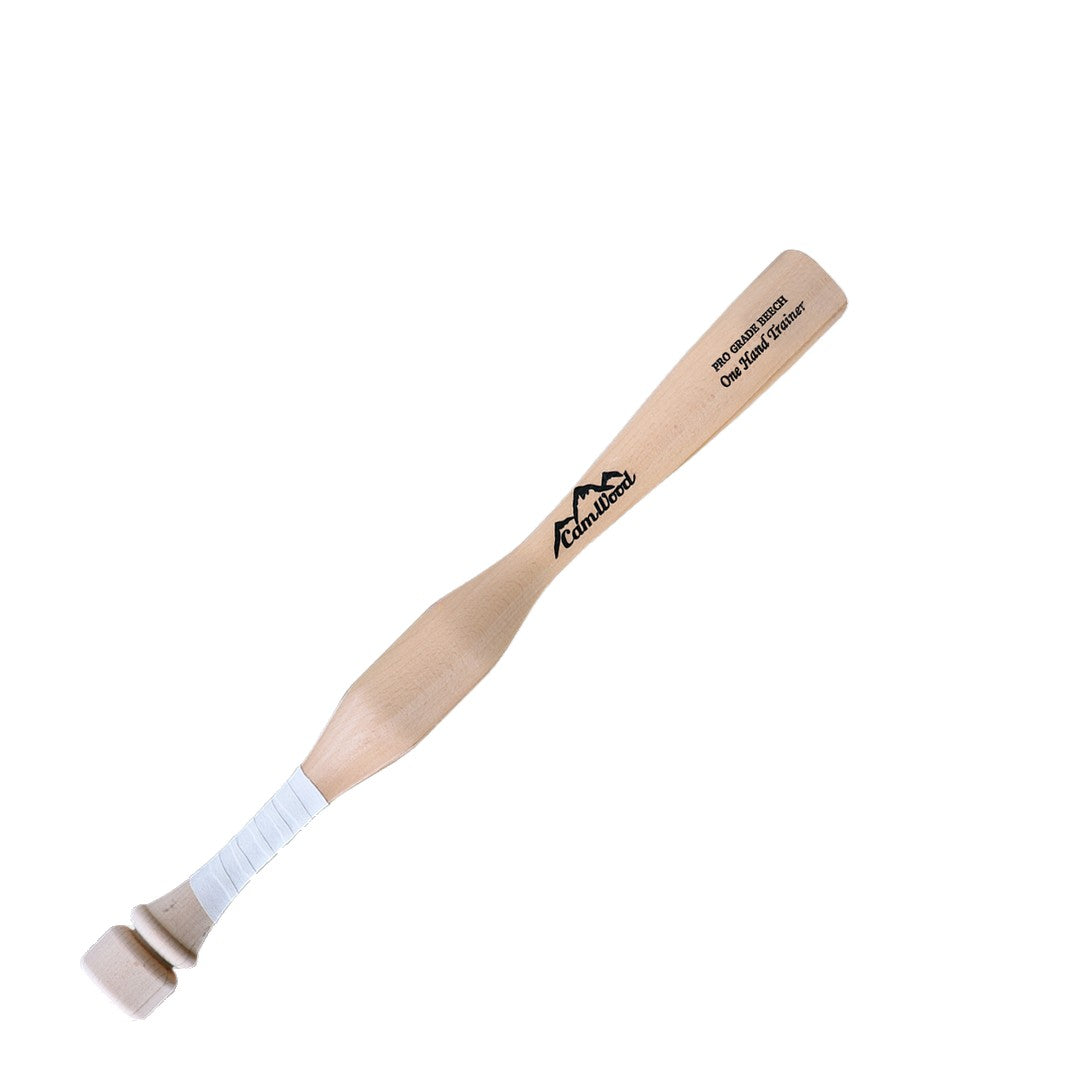
Two-handed swings hide a lot. A dominant top hand can roll over early and bury the ball into the ground, and a lazy bottom hand can let the barrel drift, while the other hand covers for it. One-hand trainers remove that cover. They are short bats, usually 18 to 28 inches, that a player can control with one hand.
- Bottom hand drills train connection and direction: lead with the knob, keep the hand inside the ball, take the barrel straight to contact.
- Top hand drills train the palm-up position at contact and a strong finish through extension, where bat speed and power show up.
The options we carry differ mostly in weight and material:
- CamWood Baseball One Hand Trainer ($59.95): beech, weighted near the hands, youth 20 inch / 23 oz or adult 25 inch / 30 oz. The softball version ($59.95) has a 24 inch / 27 oz adult size.
- ProNine OHT One Handed Training Bat ($89.95): bamboo, lighter at 16 to 18 oz in 20, 23 and 25 inch lengths.
- Valle Eagle One Hand Training Bat ($89.99): maple, 25 to 29 inch lengths.
- Old Hickory T26 One Hand Trainer Bat ($89.95): a 26 inch wood trainer durable enough for live pitching as well as tee work.
- Markwort Aluminum One Hand 18-Inch Training Bat ($29.95): very light at 10.5 oz, a good first one-hander for young players.
Weighted one-handers like the CamWood build strength while they isolate. Lighter ones like the ProNine and Markwort put the emphasis on control and repetition.
Feedback bats: barrel accuracy and hand path
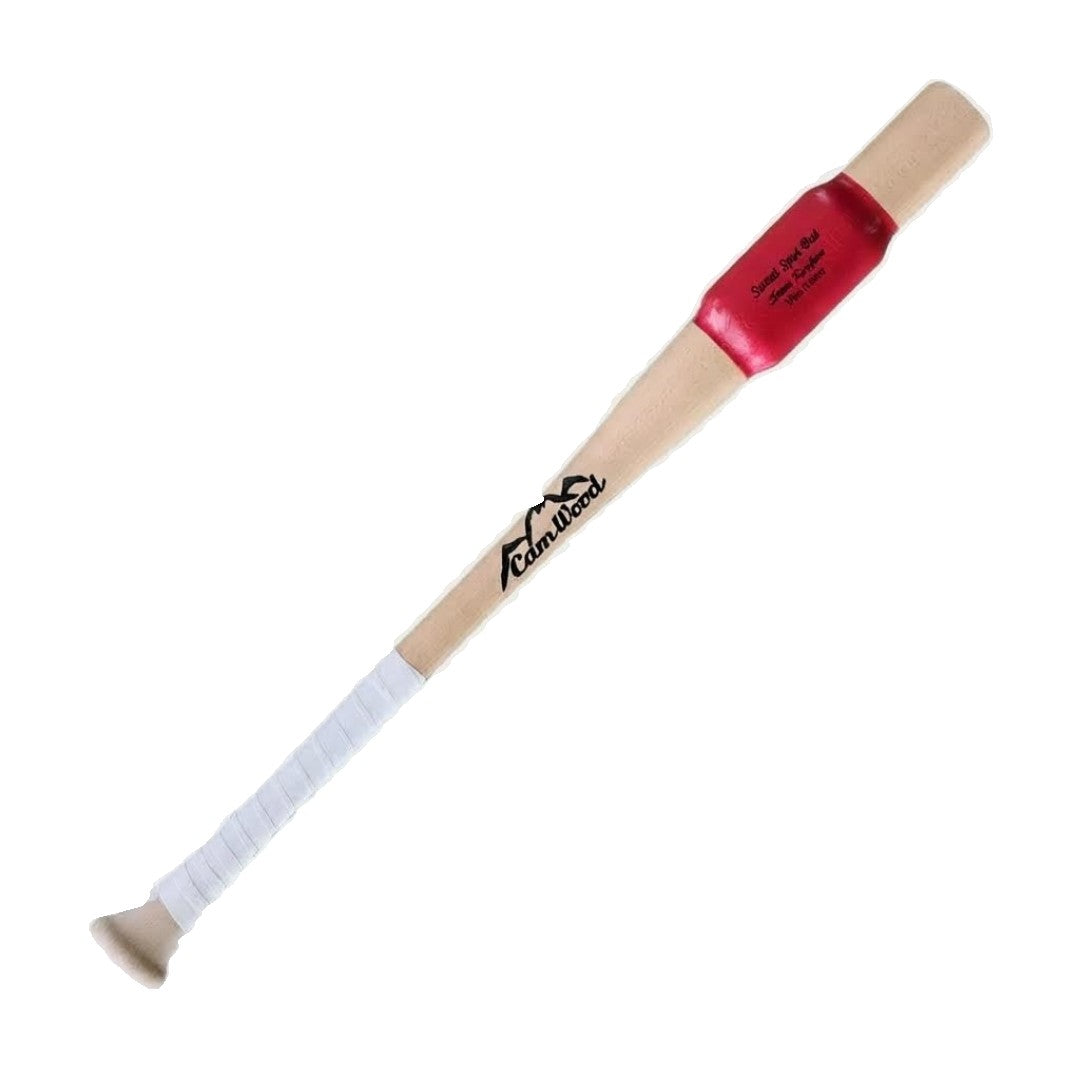
Feedback bats are a different tool. Instead of changing the load, they change what happens at contact so the hitter knows immediately whether the swing was right.
- Raised sweet spot: the CamWood Baseball Sweet Spot Bat ($109.95) and Softball Sweet Spot Bat ($109.95) have a raised 3 inch band on the barrel. Hit it and contact is solid; miss it and the hitter knows.
- Thin barrel: the ProNine Hit Stick HEC ($89.95) shrinks the barrel to 1.75 inches, and the Hitmaster GroBat ($69.99) is a small-diameter bat built for small balls. Both sharpen hand-eye coordination.
- Flat face: the ProNine Flat Training Bat ($99.95) and Old Hickory FT1 Flat Sided Trainer ($84.95) plane one side of the barrel flat. Square contact flies true; a rolled wrist shows up in the ball flight.
- Grip and wrist roll: the Mad Bat by Muhl ($59.95) uses a grip indicator to show palm-up, palm-down at contact and discourage rolling the wrists early.
Training bat comparison
| Trainer | Type | Where the weight sits | Sizes | Price |
|---|---|---|---|---|
| CamWood Baseball Hands & Speed Trainer | Hand-loaded | In and above the hands | 26-34 in, 32-46 oz | $109.95 |
| CamWood Softball Hands & Speed Trainer | Hand-loaded | In and above the hands | 26-34 in, 32-40 oz | $109.95 |
| ProNine IPTB Ideal Path | Hand-loaded | Above the hands | Youth and adult, 1 or 2 hand | $99.95 |
| ProNine FPWTB Fastpitch Weighted | Weighted, game shape | Spread along a game-size bat | 33 and 34 in, about -2 | $99.95 |
| CamWood Baseball One Hand Trainer | One-hand, weighted | Near the hands | 20 in / 23 oz, 25 in / 30 oz | $59.95 |
| ProNine OHT | One-hand | Light, even | 20, 23, 25 in, 16-18 oz | $89.95 |
| Valle Eagle One Hand | One-hand | Balanced maple | 25-29 in | $89.99 |
| CamWood Baseball Sweet Spot Bat | Feedback | Not a weight trainer | 26-34 in | $109.95 |
| ProNine Hit Stick HEC | Feedback (thin barrel) | Not a weight trainer | 30 and 33 in | $89.95 |
| ProNine Flat Training Bat | Feedback (flat face) | Not a weight trainer | 27, 30, 33 in | $99.95 |
Prices were current as of October 26, 2026 and may have changed. The product page always shows the current price.
A simple routine that uses all three
One way to put these tools together in a 20 to 30 minute tee or toss session:
- One-hand work: a short set of bottom-hand swings, then top-hand swings, off the tee with a one-hand trainer.
- Hand-loaded trainer: two-handed tee work, then front toss or soft toss, focusing on keeping the hands inside the ball.
- Feedback bat: a round with a sweet spot or flat bat to check where contact is happening.
- Game bat: finish with the game bat while the connected feel is fresh.
Keep rounds short and stop when the swing starts to break down. A tired hitter swinging a heavy bat is practicing the wrong swing. If you want a ready-made two-trainer setup, the CamWood Baseball Hands & Speed Trainer + One Hand Trainer Set ($169.90) and the softball set ($169.90) pair them in one order. CamWood also offers free Core Hitting Drills in the CamWood app that walk through this kind of tee and toss work.
Sizing and safety
- Hand-loaded trainers: match the trainer length to the player's game bat length.
- One-hand trainers: pick the length the player can control with one hand. Younger players usually start around 18 to 20 inches.
- Use real balls off a tee or toss: most weighted trainers are made for tee work, front toss and soft toss rather than live pitching. Check the product page for each bat's intended use.
- Warm up first and keep weighted rounds short, especially for younger players.
Browse every option in our training bats collection or see the full CamWood lineup.
Frequently asked questions
Do weighted bats increase bat speed?
Training with a heavier bat builds the strength used in the swing, and many hitters feel quicker when they go back to their game bat. What matters is the swing pattern you build while you do it. A trainer that keeps the weight near the hands builds strength in a compact, connected swing; heavy weight at the end of the barrel can reinforce a long one if it is overused.
What is a hand-loaded or knob-loaded training bat?
It is a training bat with its extra weight in the handle, in and just above the hands, instead of in the barrel. The CamWood Hands and Speed Trainer and the ProNine IPTB are examples. The design makes a short path to the ball the easiest swing to take, which helps hitters who cast their hands or get long.
Is a bat donut bad for your swing?
A donut is fine for a few warm-up swings on deck. The concern is volume: hundreds of practice swings with weight at the end of the barrel can pull the hands away from the body and encourage casting. For practice reps, a hand-loaded trainer teaches the swing you actually want.
What length one-hand trainer should I get?
Choose a length the player can control with one hand without the barrel dropping. Most youth players do well around 18 to 20 inches, and high school and adult hitters usually use 24 to 26 inch one-handers.
Can you hit live pitching with a training bat?
Some trainers, like the Old Hickory T26, are built to handle live pitching. Most weighted and feedback trainers are designed for tee work, front toss and soft toss. Check each product page for the intended use.
Are there softball versions of these trainers?
Yes. CamWood makes softball versions of its Hands and Speed Trainer, One Hand Trainer and Sweet Spot Bat, and the ProNine FPWTB is a weighted training bat built specifically for fastpitch softball.
