


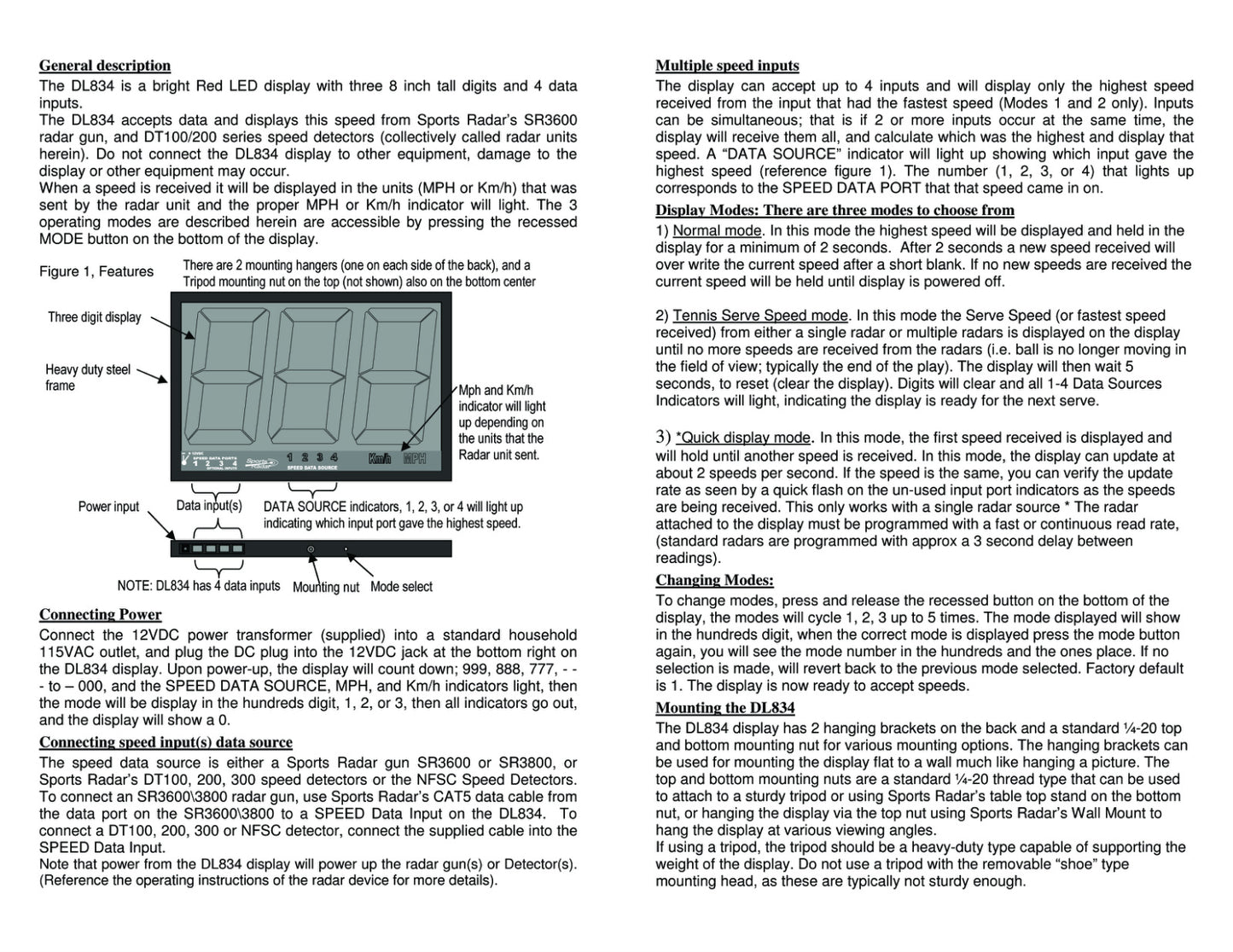
Sports Radar DL834 8 Inch Red LED Speed Display
The Sports Radar DL834 is a three digit red LED speed display with 8 inch digits, built for the moment when the number needs to reach the bleachers rather than the bullpen. It reads clearly at about 350 feet in shaded light across an extremely wide viewing angle, which covers a full baseball or softball field, a grandstand, a fan zone or a busy indoor facility. Up to four radars can feed it at once and it shows only the fastest speed of the group, so one board can serve several stations, several cages or both ends of a rink.
Start with the part that trips people up: a display is not a radar. The DL834 shows what a radar sends it, so the working setup is the board plus a speed source such as the SR3600 gun, the SR3800 gun or a DT100 speed detector, plus an RJ45 cable between them. The 12VDC power transformer is included with this display, which the smaller DL431-R is not. No data cable is included, and no gun. If you want the whole package on one line of a purchase order, the SRDL-836-KIT pairs this display with a gun, the adapter and a 25 foot cable.
Eight Inch Digits, About 350 Feet
The step from a 4 inch board to the DL834 is the step from facility distance to field distance. Ultra bright red LEDs in a heavy duty steel frame hold up at roughly 350 feet in shaded light, and the viewing angle is wide enough that spectators along the baselines read the same number as the people sitting behind the plate. Three digits means it reads up to 999, so a display ceiling is never part of the conversation on this board.
Direct sun is still the one thing to design around. LEDs wash out when the sun hits the face of the display, so aim it away from low afternoon sun or shade it. The unit is weather resistant rather than waterproof: it handles an outdoor session comfortably, but it should come in out of the rain or live inside a clear enclosure for a permanent outdoor install. The power transformer is rated for indoor use only, so plan for the transformer to sit under cover even when the board does not.
Four Radar Inputs and One Number
The DL834 accepts up to four radar sources at once and displays only the highest speed it receives, with a source indicator that lights to show which port produced the winning reading. That covers jobs no single input display can do: two guns at opposite ends of a rink feeding one central board, four cage stations sharing a readout, or a multi lane event where every lane reports to the same sign.
Power runs the other way down the same cable. Power supplied to the display feeds back along the RJ45 run and powers the connected radar gun or detector, so the radar does not need an outlet of its own at its end of the field. That is the difference between one extension cord and two on setup day.
Speed data is standard RS232 at 1200 baud over CAT5, the format every Sports Radar gun and detector produces. Cable comes in 25 foot and 50 foot lengths and stacks to a 100 foot maximum run between radar and display, with an RJ45 coupler at each join.
Mounting a Five Pound Board
Two hanging brackets are built into the back for a flat wall mount, and 1/4-20 nuts are threaded into both the top and the bottom of the case. The bottom nut takes a table top stand or a heavy duty tripod. The top nut lets the display hang from a wall mount so the face tilts down toward the crowd, which is the right answer for a board mounted above eye level.
One caution matters more than the rest: at 5 pounds in a steel frame, the DL834 is not for lightweight tripods, and a removable shoe type tripod head is the wrong hardware for it. Use the wall hangers, the table top stand or a heavy duty stand that is rated for the weight.
Display Modes
A standalone DL834 runs in normal mode, where the highest speed received is held for at least two seconds before a new reading overwrites it. That suits baseball and softball, where every pitch should stay up long enough to be read. Two other modes exist in the family firmware: a tennis serve mode that holds the fastest serve until play stops, and a quick display mode that updates about twice a second from one radar. Those have to be specified when the order is placed, so tell us up front if your event needs one.
Who the DL834 Is For
High school and college baseball and softball programs put it on the backstop or the outfield fence so the stadium sees pitch speeds during a game or a showcase. Facilities running tournaments and fundraisers use it as the centerpiece of a speed pitch attraction, where the whole point is that a crowd fifty yards away can read the number. Multi station cages feed it from several guns and let one board serve the room. It is also the display used in tennis serve speed systems, and it handles hockey and lacrosse shot speed with a gun at each end.
If the audience is inside 200 feet and the budget matters more than the size of the digits, the 4 inch DL431-R does the same job on a smaller scale, and the SRDL-36-KIT is the entry level gun and display package.
Setting It Up
Decide where the crowd sits first, then place the board so nobody has to turn away from the field to read it. Hang it on the two rear brackets or stand it on the bottom 1/4-20 nut, run CAT5 from the radar to the display, then plug the 12VDC transformer into a standard household outlet and the barrel plug into the 12VDC jack at the bottom right of the display. With the display powered, the connected gun or detector draws its power down the same cable.
On a multi radar setup, plan which port gets which radar before you run cable, since the source indicator reports by port number, and label both ends of every run. Measure the full cable path rather than the straight line distance and keep the total inside the 100 foot ceiling.
Sports Radar DL834 Specifications
- Display: three ultra bright red LED digits, 8 inches tall, reads up to 999
- Viewing distance: about 350 feet in shaded light, extremely wide viewing angle
- Data inputs: four, displays the highest speed received, with a source indicator for ports 1 through 4
- Enclosure: 16.25 in wide, 11 in high, 0.75 in deep, heavy duty steel frame
- Weight: 5 lb
- Power input: 12 to 18 VDC, 2 A maximum
- Power supply: 12VDC transformer included, plugs into a standard 115VAC outlet, indoor use only
- Power feed through: the display powers the connected radar gun or detector down the data cable
- Data format: RS232 serial at 1200 baud over CAT5 and RJ45
- Cable: 25 foot and 50 foot lengths, stackable to a 100 foot maximum run with a coupler at each join
- Mounting: two hanging brackets on the back plus 1/4-20 nuts on the top and the bottom
- Operating temperature: 40 to 110 F
- Storage temperature: 30 to 125 F
- Weather: weather resistant, not waterproof
- Compatible sources: SR3600, SR3800, DT100, DT200 and DT300 detectors, NFSC radar units
- Warranty: 1 year limited
- Made in the USA
What's Included
The DL834 arrives with its 12VDC power transformer and instruction manual. There is no data cable in the box and no radar, so order the cable length your install needs and a gun or detector to feed it. The SRDL-836-KIT is the matched package if you would rather buy the gun, the board, the adapter and the cable together.
Frequently Asked Questions
Is the power supply included with the DL834?
Yes. A 12VDC transformer ships with the display and plugs into a standard household outlet, and spare power adapters are listed separately. The transformer is rated for indoor use, so keep it under cover on an outdoor setup.
Can I connect more than one radar gun to it?
Yes, up to four. The board reads all four inputs at once and shows only the fastest speed, and an indicator lights to tell you which port that speed came from.
Does the radar gun need its own outlet?
No. Power fed to the display travels back down the data cable and runs the connected gun or detector, so one power source covers both ends.
How far away can the crowd read it?
About 350 feet in shaded light, with a very wide viewing angle. Direct sunlight on the face of the display is what cuts that number down, not distance alone.
Can I leave it set up outdoors?
It is weather resistant, not waterproof. Bring it in out of the rain or house it in a clear enclosure for a permanent outdoor position, and keep the transformer under cover.
Can I put it on a camera tripod?
No. At 5 pounds in a steel frame it needs the rear wall hangers, a table top stand or a heavy duty stand. Lightweight tripods and removable shoe type tripod heads are not suitable.
How far can the display sit from the gun?
Up to 100 feet, using 25 foot and 50 foot CAT5 lengths stacked with a coupler at each join.
