


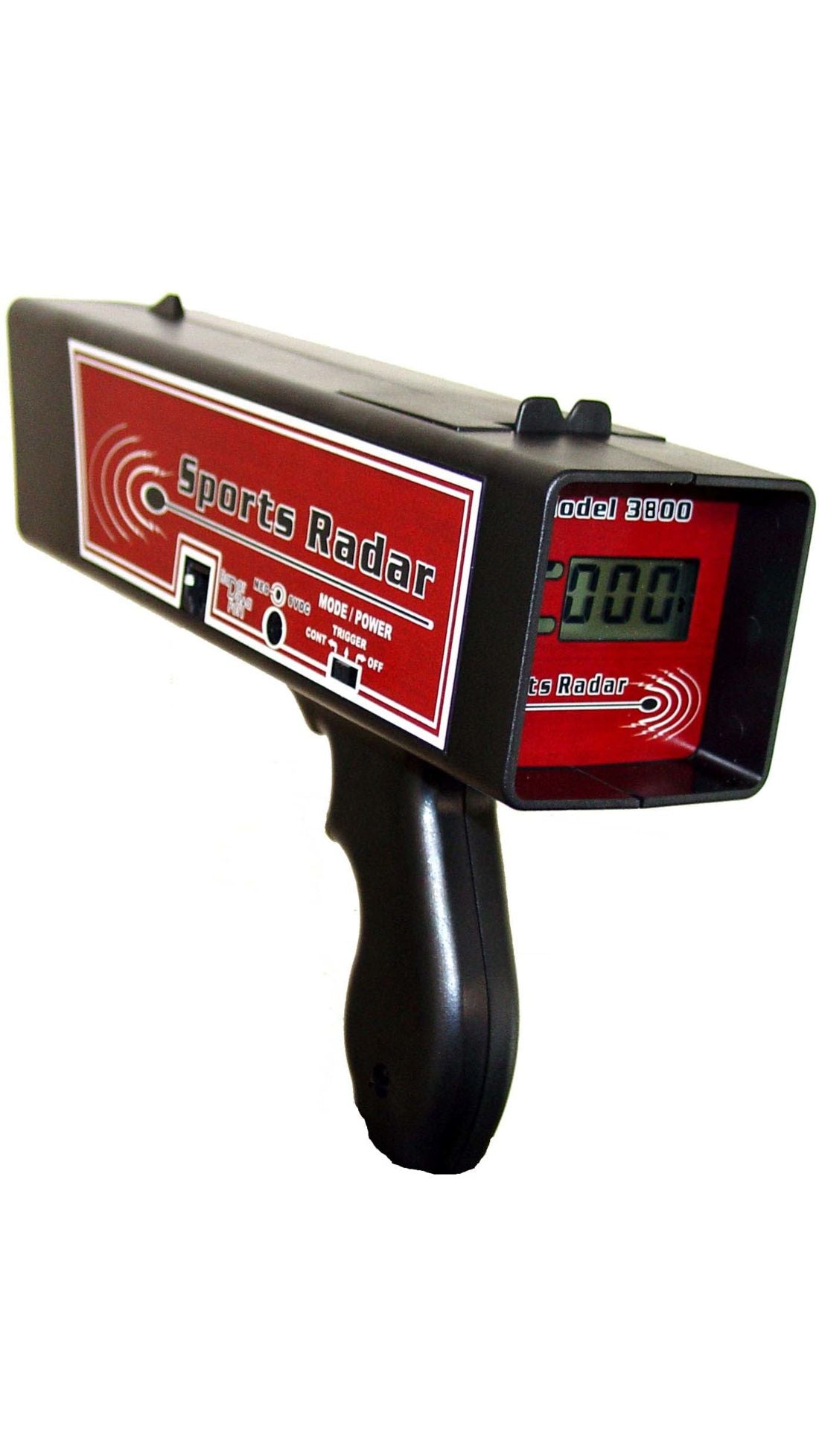
Sports Radar SR3800 Mid Range Radar Gun
The Sports Radar SR3800 is the mid range gun in the line and the only model here that reports pitch speed and plate speed from the same throw. Pull and hold the trigger and the display shows what the ball was doing out of the hand, then what it was doing when it crossed the plate. For a pitching coach or a scout, that pair of numbers says more about a fastball than either number says alone.
It reads from 10 to 250 MPH and holds a baseball out to 150 feet at its lowest noise filter setting, roughly double the reach of the SR3600 and enough to work from behind a backstop. At 0.85 pounds it is the lightest of the data port guns, it runs on batteries, wall power or straight off a Sports Radar display, and it is made in the USA.
Pitch Speed and Plate Speed from One Throw
This is the reason to buy the SR3800. In trigger mode, a quick pull and release gives you the fastest speed of the pitch, the way any gun works. Hold the trigger instead of releasing it and the readout toggles: first the pitch speed, then the plate speed, from that same delivery.
The gap between the two is the useful part. Every pitch loses speed on the way to the plate, and how much it loses is a property of the pitch. Two fastballs that leave the hand at the same number can arrive very differently, and the pitcher whose ball holds its speed is the one hitters describe as having late life. A change up should give up more; a well thrown four seam should give up less.
Plate speed also explains why two guns at the same game disagree. One behind the plate and one behind the mound are measuring the ball at different points in its flight, and reading both ends with a single instrument makes that difference visible.
One limit worth knowing before you buy: when readings are sent to a computer through the data port, only the pitch speed is recorded. Plate speed is a display feature on the gun itself.
Reading Range and Working Through a Backstop
Reading range is 150 feet on a baseball with the noise filter at its nF1 setting, and range is optimized between 30 and 100 MPH. That is the number that lets a coach stand behind the backstop or up in the stands instead of crowding the bullpen. Chain link is not a wall to X band radar, so reading through backstop fencing from a normal seat is realistic as long as you stay inside the range and keep the angle honest.
Position still decides accuracy. Radar measures the part of a ball's motion heading directly toward or away from the gun, so an operator off to the side of the flight path always reads low. Straight behind the plate or straight behind the pitcher gives a true number; drifting off that line explains most readings that look slow.
The Noise Filter, the Beeper and the Setup Menu
Indoor cages are hostile to radar. Fluorescent lights, fans, motors, HVAC equipment and a second gun in the next lane all produce readings nobody threw. The SR3800 answers that with a noise filter running from nF1 to nF9.
The trade is straightforward. nF1 filters least and reaches furthest, which is the setting behind the 130 foot number. nF9 filters hardest and pulls the readable distance in to about 20 feet, which is what you want in a crowded indoor facility. The gun starts at nF2 every time it powers on, so most users set it for the room they are in.
Holding the trigger while powering on opens the preferences menu: units, fastest speed only or the pitch plus plate pair, the noise filter, a 2.5 or 0.5 second delay between continuous readings, and the beeper. Silencing the beeper matters more than it sounds, because a coach charting from the stands during a game does not want a tone on every pitch. Preferences persist through power cycles.
Power for Handheld, Cage and Permanent Setups
Three power paths cover every way this gun gets used. Two standard 9V alkaline batteries make it fully portable, and they last up to 12 hours of continuous running or around 60 hours of typical trigger use. A 9V or 12V wall adapter handles a cage, a booth or a camp station that runs all day. The third path is the one almost nobody talks about: the gun can be powered directly from a Sports Radar display through the data cable, so a permanent install has one power drop and no batteries to remember.
The jack senses external power and takes over automatically, so batteries can stay in place as a backup. Batteries are not included with the gun.
The Data Port, Displays and Software
The RadarDataPort is an RS232 serial output built for Sports Radar equipment. It drives the 4 inch red LED display and the larger boards, which is how a cage, a fundraiser booth or a facility puts the number where a crowd can read it. The SRDL-38-KIT pairs this gun with a 4 inch display, an adapter, a cable and a hard case; note that the kit built to work with inflatable speed pitch setups is the SRDL-36-KIT, not this one.
For logging rather than displaying, the speed acquisition software records readings on a Windows computer through the serial adapter included with it. Never run a plain serial cable from the gun into a computer; the port is for Sports Radar adapters and displays only, and a direct connection can damage both.
Who This Radar Gun Is For
The SR3800 is the choice for high school, travel and college baseball programs, pitching instructors, scouts, showcase operators and facilities that want one gun capable of charting from a distance and reporting a pitch plus plate pair. The 130 foot reach and the silent option make it usable during a game, and the noise filter makes it usable in a cage.
If your work is all inside 60 feet and you do not need plate speed, the SR3600 covers it for less. If you need to measure things moving slower than 10 MPH, the SR3800-LS keeps the pitch and plate feature with a 4 MPH floor, though it gives up range and top end to get there.
Training Applications for the SR3800
Bullpen and side work is the daily use. Chart pitch and plate speed by pitch type and you can see whether a change up is separating properly from the fastball at both ends of its flight, not just at release.
In game charting is what the range and the silent beeper are for. From behind the backstop a coach can chart a full outing without a tone on every pitch and without standing somewhere that draws attention.
Cage and facility installs are where the display power option pays off. The gun mounts once, powers off the display, and reads every rep without staff involvement.
Exit velocity work reads well, because a Doppler gun measures the speed of a moving ball whether a hand or a bat put it in motion. Bat speed itself is a different measurement and needs a different device.
Sports Radar SR3800 Mid Range Radar Gun Specifications
- Speed range: 10 to 250 MPH (16 to 403 Km/H)
- Accuracy: 1 MPH
- Reading range on a baseball: 150 feet at the nF1 noise filter setting
- Range optimized between 30 and 100 MPH
- Radar band: X band, 10.525 GHz
- Display: 3 digit LCD
- Modes: trigger with pull and release for fastest speed or pull and hold for pitch plus plate speed, and continuous hands free operation
- Noise filter: nF1 through nF9, nF2 at power up; nF9 reduces reading distance to about 20 feet
- User settings: units, speed display mode, noise filter, 2.5 or 0.5 second delay between continuous readings, beeper on or off
- Power: two standard 9V alkaline batteries, a 9 to 12VDC wall adapter, or power from a Sports Radar display; the jack senses external power automatically
- Battery life: up to 12 hours continuous, about 60 hours in typical trigger use
- Data output: RadarDataPort RS232 serial, for Sports Radar displays and adapters
- Weight: 0.85 lb
- Dimensions: 10-3/4 in L x 2-3/4 in W x 7-1/4 in H
- Operating temperature: -10 to 130 F; storage -20 to 155 F
- Mounting: standard tripod thread
- Origin: made in the USA
- Warranty: 1 year limited
What's Included
- SR3800 radar gun
- User manual
- Warranty registration card
Batteries are not included; the gun takes two 9V cells. Sold separately: the hard carry case, the 52 inch tripod, wall and vehicle power adapters, the 65 MPH tuning fork, remote LED displays and the computer software package.
Frequently Asked Questions
How do I get pitch speed and plate speed?
Pull and hold the trigger instead of releasing it. The display shows the pitch speed first, then the plate speed from the same throw. Pitch plus plate is a trigger mode feature, selected in the setup menu you reach by holding the trigger while powering on.
Will it read through a backstop?
Yes. X band radar passes through chain link, so working from behind a backstop is a normal way to use this gun. Stay within the 130 foot range and keep the gun in line with the ball's flight.
Can I turn the beeper off?
Yes, in the setup menu. Coaches charting from the stands during a game usually turn it off so there is no tone on every pitch.
Are batteries included, and can I run it on wall power?
Batteries are not included; it takes two 9V cells. You can also run it from a 9 to 12VDC wall adapter, or power it directly from a Sports Radar display over the data cable for a permanent install. The gun switches to external power on its own.
What is the noise filter for?
Rejecting false readings from lights, fans, motors, HVAC equipment and other guns nearby, which is mostly an indoor problem. Raising the filter costs range: nF1 reaches 150 feet and nF9 pulls in to about 20 feet.
Does the computer software record plate speed too?
No. Only pitch speed is sent to the software. Plate speed is read on the gun's own display.
How do I verify it is still accurate?
Use the 65 MPH X band tuning fork. Strike it, hold it in front of the gun, and look for 65 on the display. That is a verification check rather than a calibration; these guns have no user calibration, so a fork reading that is off means the unit needs service.
