


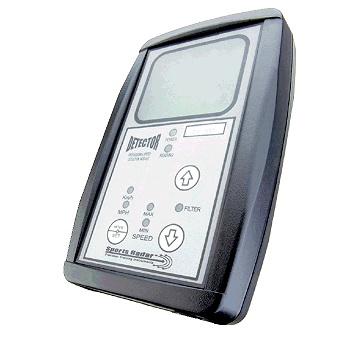
Sports Radar DT100 Speed Detector Unit
The Sports Radar DT100 is a fixed mount radar sensor, not a handheld radar gun, and that difference matters before anything else. It has no screen, no trigger, no batteries and no power switch. It bolts or straps into a fixed position behind a net, and a single cable carries both power and data between it and a Sports Radar LED speed display. On its own it does nothing at all. Paired with a display it becomes the sensor half of a speed pitch booth, a cage speed station or a permanent tunnel readout.
That is the whole product and it is worth being blunt about, because buyers regularly order a detector expecting a radar gun and end up with a sealed box and a cable. If what you want is a device you hold and aim, look at a handheld gun such as the SRA3000 Tracer instead. If what you want is a permanent installation where a pitcher throws and a big number appears on a board, the DT100 is one of the two pieces you need.
What You Need to Buy With a DT100
A display is required, not optional. The DT100 sends its readings over a serial connection and something has to receive them. Two Sports Radar displays cover most installations. The DL431-R uses three 4 inch high brightness LED digits, is readable from over 150 feet and runs on 9VDC. The DL834 uses three 8 inch ultra bright digits, is readable up to 350 feet, runs on 12VDC and accepts up to four detectors at once while indicating which one recorded the highest speed. A power supply for the display is required as well, since the detector draws its power through the display.
The detector arrives with a 25 foot power and data cable permanently attached to it. Longer runs are handled by adding CAT5 network style extension cable with a coupler, and no maximum total run is published. If the readings need to go to a computer rather than a board, that is what the DET-PC-02 detector software package is for. It supplies the software along with the adapter that safely converts the detector cable to a serial port, which is the only correct way to make that connection.
Eight Foot Side by Side Isolation for Multi Lane Booths
The DT100 is the only detector in the Sports Radar range rated to run beside another unit at 8 feet of separation without the two reading each other. For a single lane that is a curiosity. For a two, three or four lane speed pitch setup it is the whole decision, because cross reading between adjacent lanes is what turns a head to head competition into an argument.
That capability pairs directly with the DL834, which accepts up to four detectors and shows which lane produced the highest speed. Four DT100 units, one DL834 and a cable run gives you a four lane competition board from one display. The DT100 is also built to shrug off the motors and blower fans typical of inflatable speed pitch games, which is the other noise source that ruins readings in that environment. If you are building anything with more than one lane, this is the detector to use rather than the longer range DT200.
Range, Mounting and Alignment
Typical detection range is 8 feet, which is short by design. The DT100 is meant to sit right behind the target, so a short range keeps it deaf to everything happening elsewhere in the building. Mount it 1 to 6 feet behind the receiving net and line it up with the path of the ball, because the same angle rule that governs handheld guns governs a fixed sensor. Anything off the line of travel reads low.
The unit comes with a swivel bracket base that gives you several ways to fix it in place. Two 5/32 inch holes take screws into wood or masonry. The same holes take tie wraps, two per hole, for mounting to a metal fence, a post or a bar. There is also a standard 1/4-20 tripod nut in the housing if a camera tripod suits the site better. For a solid or chain link back wall, mount the detector on the net side. For an inflatable or vinyl back wall, it can be mounted on the outside and read through the material. Secure the cable roughly every 5 feet so the run is not taking any strain at the connector.
Speed Window, Noise Filter and On Board Memory
The DT100 detects from 25 to 175 MPH, or 40 to 240 Km/H, and readings can be output in either unit. Inside that range it carries programmable minimum and maximum speed limits so only speeds within a window you choose are registered, which keeps stray activity in the building off the board. From the factory the window is set wide open at 25 and 175 MPH.
The noise filter is programmable between 8 and 50 and ships set to 8. A lower number gives more range and more false readings, a higher number gives fewer of both. The right method when a unit reads the tuning fork but not a pitch is to bring the filter back down toward 8, then raise it a step at a time until the false readings stop. A roughly 3 second delay sits between readings and the red reading indicator goes dark while it runs, so rapid fire throwing holds a number on the board rather than flickering. The detector also stores up to 1000 speeds in on board memory, which can be pulled down to a computer with the detector software package.
Who the Sports Radar DT100 Is For
The buyer here is a facility rather than an individual. Speed pitch booth operators, carnival and inflatable game operators, batting cage and training tunnel owners, school and municipal recreation departments, and anyone building a permanent speed station where a display is part of the point.
It is the wrong purchase for a coach who wants to clock a bullpen or a parent at a game, since those are handheld gun jobs, and the wrong choice if the sensor has to sit further back than about 8 feet, which is what the DT200 is built for.
Installing and Using the DT100
A working installation is four things: the detector, a display, a power supply for the display, and enough cable between them. Mount the detector behind the net in line with the ball, run the cable to the display and secure it along the way, power the display, and check the whole chain with a tuning fork before anyone throws. A correct unit reads a struck 65 MPH fork at about 65 MPH. Sports Radar no longer ships a fork with its products, so order one separately if you want to spot check.
Because the detector has no power of its own, a dead system is nearly always a display, cable or power supply fault rather than a failed radar. Corroded connector pins on an outdoor run are a known cause. The 10 MPH detection floor is worth planning around for a youth event, since throws slower than that will not register at all and a booth aimed at small children needs that expectation set at the sign rather than at the display. The unit is weather resistant and is installed indoors and outdoors.
Sports Radar DT100 Specifications
- Product class: fixed mount radar sensor with no display on board
- Speed detection range: 25 to 175 MPH, or 40 to 240 Km/H
- Typical detection range: 8 feet
- Side by side operation: adjacent units at 8 feet separation without cross reading
- Programmable minimum and maximum speed limits, factory set to 25 and 175 MPH
- Programmable noise filter, settings 8 to 50, factory default 8
- Reading delay: about 3 seconds, with the red reading indicator off during the delay
- On board memory: up to 1000 recorded speeds, downloadable to a computer
- Data output: serial communications at 1200 baud
- Cable: permanently attached 25 foot power and data cable with an RJ45 network style plug
- Power: none on board, drawn from the connected display over the same cable
- Units: MPH or Km/H, selectable
- Mounting: swivel bracket base, two 5/32 in holes for screws or tie wraps, plus a 1/4-20 tripod nut
- Weather resistant for indoor or outdoor installation
- Made in the USA
Sports Radar covers the DT100 with a 1 year limited warranty.
What Is Included with the DT100
- DT100 radar unit with a permanently attached 25 foot power and data cable
- Mounting and alignment bracket with screws
- Instruction manual
A display is not included and the detector will not show a speed without one. Neither is the power supply the display needs, nor any extension cable beyond the 25 feet attached to the unit, nor the DET-PC-02 software package required for computer use. Plan the full chain before ordering.
Frequently Asked Questions
Does the DT100 have a screen?
No. It is a sensor with no display, no trigger and no battery. It must be connected to a Sports Radar LED speed display, or to a computer through the detector software package, before it will show a speed anywhere.
What else do I need to buy for a working setup?
A display and a power supply for it, at minimum. The DL431-R covers most indoor and close range installations, and the DL834 is the choice when the board has to be readable from across a field. Add extension cable if the display sits more than 25 feet from the detector.
Can I run several units in adjacent lanes?
Yes, and the DT100 is the only detector in the line rated for it. Units 8 feet apart will not read each other, and a DL834 accepts up to four detectors while showing which one produced the highest speed.
Where exactly does it mount?
One to six feet behind the receiving net, lined up with the path of the ball. On a solid or chain link back wall, mount it on the net side. On an inflatable or vinyl wall, it can go on the outside.
Can I run the cable straight into a laptop?
No. That cable carries power as well as data and connecting it directly to a computer can damage both ends. The DET-PC-02 package exists for this and includes the correct adapter.
What is the slowest speed it will register?
10 MPH. Anything slower will not appear on the display at all, which is worth knowing before setting up a booth for young children.
How far can the cable run?
The attached cable is 25 feet and it can be extended with 25 or 50 foot cables and a coupler. No maximum total run is published, and the cable should be secured about every 5 feet so the connector never takes the strain.
