


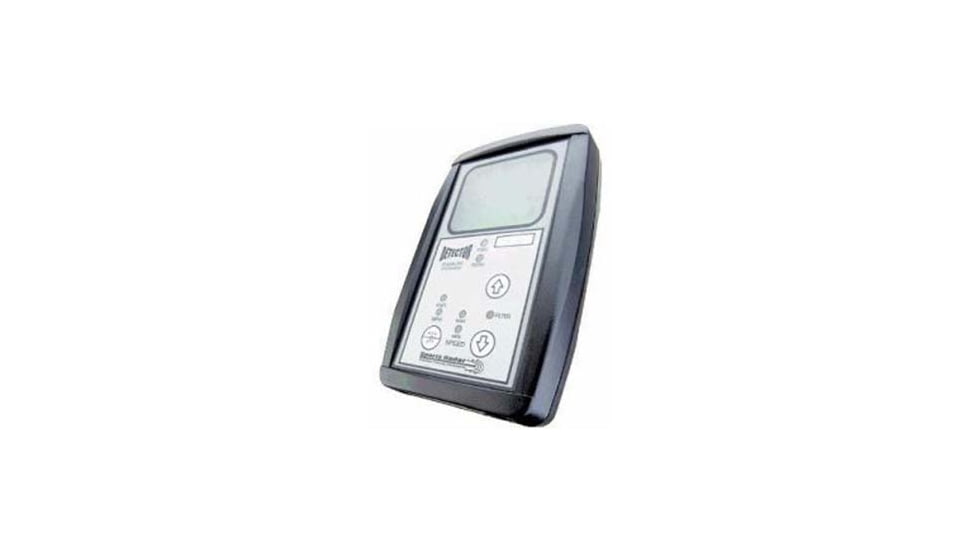
Sports Radar DT200 Speed Detector Unit
The Sports Radar DT200 is a fixed mount radar sensor, not a handheld radar gun. It has no screen, no trigger, no batteries and no power switch of its own. It mounts in a fixed position, and a single cable carries both power and data between the sensor and a Sports Radar LED speed display. Nothing happens until it is connected to that display, so the DT200 is always bought as one half of a system rather than as a device on its own.
What it adds over the shorter range detector in the line is distance. The DT200 detects up to 50 feet, against roughly 8 feet for the DT100, which makes it the right sensor for open situations where you simply cannot mount the radar a few feet behind the target. Think a baseball field, a tennis court, or any installation where the display and the sensor have to sit back from the action.
Where the DT200 Sits in the Detector Line
The DT200 is the mid range detector, and it is worth saying so directly because it is often described as a long range unit. It is not the longest reaching sensor Sports Radar builds, and the range figure to plan around is up to 50 feet. Buy it because 50 feet is what your installation needs, not because a label implied more.
It is also worth being clear about what the DT200 does not claim. The 8 foot side by side isolation that lets multiple detectors work in adjacent lanes without reading each other is specific to the DT100 and is not stated for this unit. If you are building a two, three or four lane speed pitch setup where units sit close together, use DT100 sensors. The DT200 is for a single reading position that needs to see further, not for banks of sensors sitting side by side.
What You Need to Buy With a DT200
A display is required. The DT200 outputs its readings over a serial connection and something has to receive and show them. The DL431-R uses three 4 inch high brightness LED digits and is readable from over 150 feet. The DL834 uses three 8 inch ultra bright digits and is readable up to 350 feet, which is usually the right pairing for a DT200, since an installation that needs 50 feet of detection range generally also needs a board people can read from the stands.
A power supply for the display is required too, because the detector has no power input of its own and draws what it needs through the display over the same cable. The attached cable is 25 feet and longer runs are made with CAT5 network style extension cable. If the readings need to reach a computer instead of a board, the DET-PC-02 detector software package supplies both the software and the adapter that converts the detector cable to a serial port safely. Do not connect the detector cable to a computer without that adapter, because it carries power as well as data.
Range, Speed Window and Filtering
Detection range is up to 50 feet and the detection band is 25 to 175 MPH, or 40 to 240 Km/H, with output selectable in either unit. Alignment governs accuracy exactly the way it does on a handheld gun. Mount the sensor in line with the path of the ball, both horizontally and vertically. Anything off that line reads low, and at 50 feet a small mounting error becomes a large angle at the target.
The DT200 carries programmable minimum and maximum speed limits so only speeds inside a window you set are registered, which keeps a public facing board from displaying a number every time something irrelevant moves through the beam. It also carries a programmable sensitivity and noise filter. Lower filter settings reach further and pick up more spurious readings, higher settings do the opposite. In an open outdoor installation you will usually want the filter low. Indoors, or anywhere near fans, motors, lighting ballasts or traffic, expect to raise it until the unexplained readings stop. Speeds are held in on board memory as well as being sent to the display.
Who the Sports Radar DT200 Is For
The DT200 suits facilities rather than individuals. Baseball fields putting pitch speed on a board for players and spectators, tennis courts showing serve speed, training facilities where the sensor has to sit back from the throwing or hitting position, and installations monitoring traffic speed on a site. It works indoors or outdoors and is weather resistant, so a permanent outdoor mount is a normal use rather than an exception.
It is the wrong product for a coach who wants something to carry and aim, which is a handheld gun job. It is the wrong product for a multi lane booth, where the DT100 is the sensor rated for close side by side operation. And it is more sensor than a single enclosed cage needs, since a cage installation can usually put a DT100 within a few feet of the net and spend less doing it.
Installing and Using the DT200
A working installation is the detector, a display, a power supply and enough cable between them. Fix the sensor in a stable position aligned with the path of the ball, run the cable to the display and support it along the run so the connector never carries the weight, then power the display and confirm the whole chain before an event. A tuning fork check is the fastest way to confirm the sensor and the board are talking to each other, because a correct reading of the fork proves everything between them works.
Because the detector has no independent power, a system that shows nothing is far more likely to be a display, power supply or cable fault than a failed sensor. Check those first. On outdoor installations, corroded connector pins are a recurring cause and a sheltered mounting position for the connection pays for itself. Plan the 10 MPH detection floor into any event where slower throws are expected, since anything under that will not register on the board at all.
Sports Radar DT200 Specifications
- Product class: fixed mount radar sensor with no display on board
- Detection range: up to 50 feet
- Speed detection range: 25 to 175 MPH, or 40 to 240 Km/H
- Programmable minimum and maximum speed limits
- Programmable sensitivity and noise filter
- On board speed storage
- Data output: serial communications at 1200 baud
- Cable: permanently attached 25 foot power and data cable with an RJ45 network style plug
- Power: none on board, drawn from the connected display over the same cable
- Units: MPH or Km/H, selectable
- Weather resistant, for indoor or outdoor installation
- Intended for baseball fields, tennis courts and traffic monitoring
- Made in the USA
Sports Radar covers the DT200 with a 1 year limited warranty.
What Is Included with the DT200
- DT200 radar unit with a permanently attached power and data cable
A display is not included and the sensor will not show a speed without one. A power supply for the display is not included, nor is extension cable beyond the 25 feet attached to the unit, nor the DET-PC-02 software package needed for computer use. Price and plan the complete chain before ordering, since a detector on its own cannot be tested or used.
Frequently Asked Questions
Does the DT200 have a display?
No. It is a sensor with no screen, no trigger and no battery. It has to be wired to a Sports Radar LED speed display, or to a computer through the detector software package, before it will show a speed.
How much more range does it have than the DT100?
Roughly six times. The DT200 detects up to 50 feet and the DT100 is around 8 feet. That is the main difference between the two units.
Is this the longest range detector Sports Radar makes?
No. The DT200 is the mid range unit in the detector line despite being described elsewhere as long range. Plan your installation around up to 50 feet.
Can I run two of them side by side in adjacent booths?
Not per the specifications. The 8 foot side by side isolation rating belongs to the DT100 only, so multi lane setups should use DT100 sensors.
What is the slowest speed it will register?
10 MPH. Anything slower will not reach the display, which matters for youth events and for any public facing board where a blank screen looks like a fault.
Which display should I pair it with?
The DL834 with 8 inch digits is the usual match, because an installation that needs 50 feet of detection range normally needs a board readable from a distance too. The DL431-R with 4 inch digits works where viewers are closer.
Can I connect it to a computer?
Yes, through the DET-PC-02 package, which includes the software and the adapter that converts the detector cable to a serial port. Connecting the cable directly to a computer can damage both, because it carries power as well as data.
