


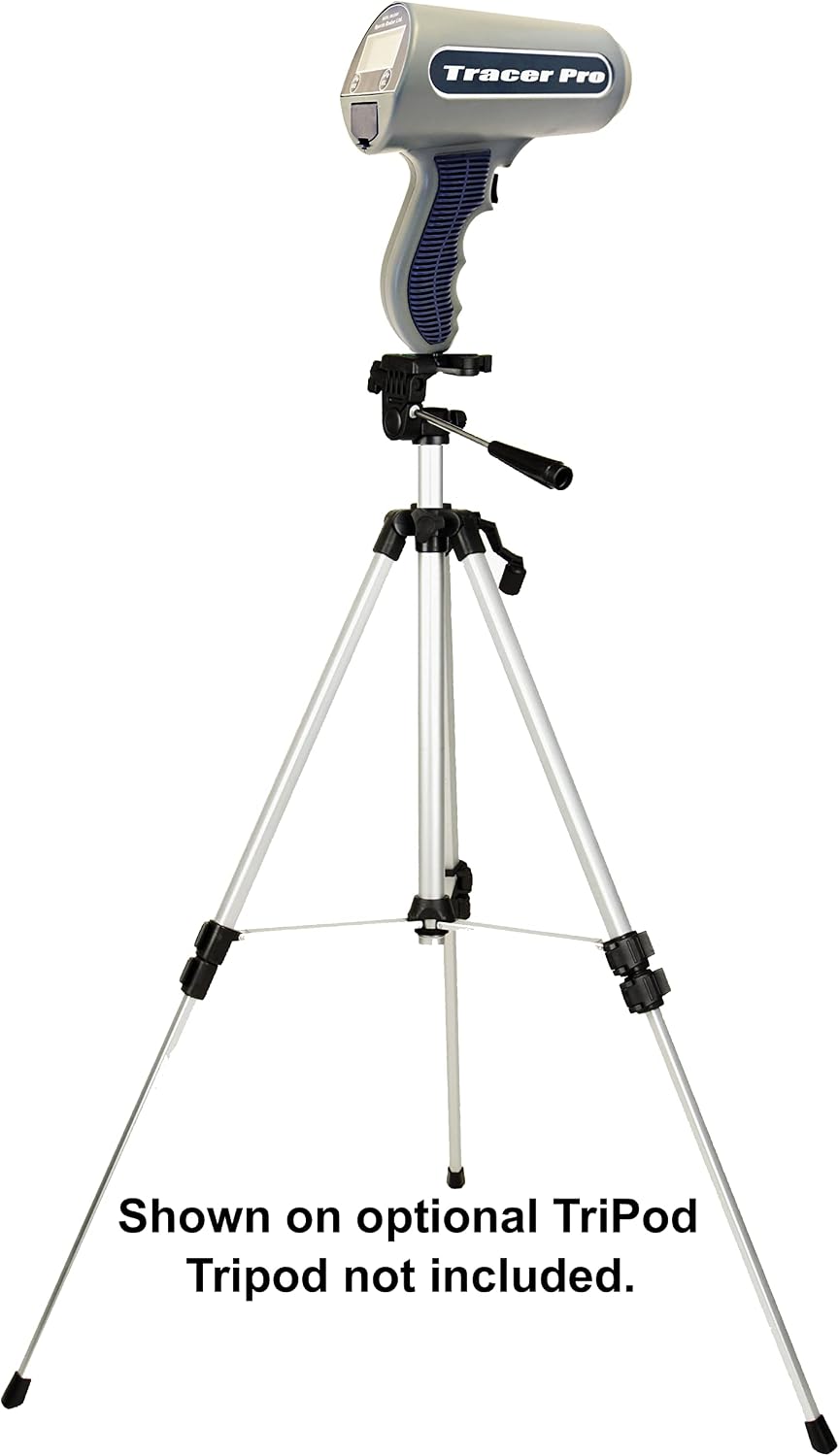
Sports Radar SRA3000 Pro Tracer Radar Gun
The Sports Radar SRA3000 Pro is the long looking version of the Tracer, and range is the entire reason it exists. Where the standard Tracer reads a ball to about 60 feet, the Pro reads to 150 feet with its noise filter set to F1, and it reads through a chain link fence. That is the difference between standing in the bullpen and standing behind the backstop at a full size field, which is where most coaches actually want to be.
The Pro is a physically different gun rather than a software option. The body is larger at 6.5 by 3.2 by 7.5 inches, it weighs 1 lb, and it adds a three position noise filter that is what buys the extra distance. It keeps the Tracer family features, including Quick Read mode for bat and club swing speeds and a recall for both average and highest speed, and it runs on six AAA cells like the rest of the family.
150 Feet at Filter F1 and Reading Through a Backstop
Range on a baseball is 150 feet with the noise filter at F1, and the filter setting is not a footnote. F1 is the default and the least aggressive setting, and it is where the headline number lives. Move the filter up and you trade distance for a cleaner signal.
The Pro is also built to read through chain link, which is the single most common real world request in this category. A coach behind a backstop, a parent behind an outfield fence and an instructor outside a cage net are all asking the same thing, and the answer here is yes rather than a qualified maybe. Combine that with a tripod and the Pro becomes a station that can sit behind the plate and record a whole bullpen while the coach does something else.
The Three Position Noise Filter
Radar picks up more than the ball. Fluorescent lighting, HVAC fans, motors, monitors and passing traffic all put energy into the same band, and indoors that noise is what produces readings nobody can explain. The Pro handles it with three filter settings and it is honest about the cost of each.
F1 is the default, filters the least and gives the full 130 foot range. F2 sits in the middle and cuts range by roughly half in exchange for a cleaner read. F3 filters hardest for genuinely noisy short range environments and pulls range back to around 30 feet. The practical method is to start at F1, and only step up if you are seeing readings that do not match anything that happened. Most outdoor field work never leaves F1. A busy indoor facility with fans running often lands on F2 or F3 and is better for it.
Quick Read, Average and Highest Speed Recall
Quick Read is the Tracer family mode built for targets that only travel a short distance, which is what a bat head or a club head gives a radar gun. It is the reason the Tracer family answers the swing speed question at all, and neither the SR3600 nor the SR3800 has it. On the Pro, Quick Read runs inside continuous mode and takes about three speeds per second.
The Pro also recalls both the average and the highest speed from a set. Those two numbers together are far more useful than either alone, because the highest tells you what the athlete is capable of and the average tells you what they are repeating. A pitcher whose top reading climbs while the average stays flat is a different coaching problem from one whose whole set moves up together.
How the Pro Compares Inside the Sports Radar Line
Against the standard SRA3000, the Pro roughly doubles range on a ball and adds the filter control, in exchange for a larger body, a heavier 1 lb gun and shorter battery life at about 65 hours in trigger mode against roughly 100 on the base Tracer. If you work at bullpen and cage distances, the standard Tracer is the better buy. If you work from behind a fence, the Pro is the only Tracer that does it.
Against the SR3800, the comparison is cleaner than most people expect. The two guns land in similar territory on range, but the SR3800 adds two things the Pro does not have. Pulling and holding its trigger returns pitch speed and plate speed on the same throw, which is what a pitching coach uses to see how much a fastball is losing on the way in. It also carries the RadarDataPort, the serial output that drives Sports Radar LED speed displays and the PC package. If you want a scoreboard readout or logged data, that is the path. If you want range at the lowest cost in the line, the Pro is it.
Who the SRA3000 Pro Is For
This is the gun for coaches who stand behind a backstop, for travel and high school programs clocking games and scrimmages, for showcase and tryout operators who need a reading from a safe distance, and for facilities that run indoors and need filter control to keep their numbers clean. It is also the natural pick for anyone who looked at the standard Tracer, liked everything about it and then realized 60 feet was not going to reach.
It is not the right gun if a scoreboard display or PC logging is part of the plan, and it is not the right gun if reading genuinely slow targets is part of the job. For the slow end of the range the SRA3000-LS reads from 4 MPH and is built for exactly that.
Training and Game Applications
Behind the backstop, stand in line with the pitch and keep the filter at F1 for maximum distance. Angle is still the thing that costs you accuracy, so being directly behind the plate matters more than being close. For a bullpen, a tripod plus continuous mode lets the gun record while the coach works with the pitcher rather than holding a trigger.
For hitting work, Quick Read gives you swing speed while normal reading gives you the ball speed off the bat, and running both across a session shows whether a change moved the bat, the ball or nothing at all. Indoors, expect to spend some time finding the filter setting that suits the building, then leave it there. In a cage or tunnel, F2 or F3 will usually be steadier than F1 even though the range number looks worse on paper, because at those distances you have distance to spare and noise is the real enemy.
Sports Radar SRA3000 Pro Specifications
- Reads up to 199 MPH or Km/H
- Accuracy: 3 percent, resolution 1 MPH or 1 Km/H
- Range on a baseball: up to 150 feet at filter setting F1
- Reads through chain link fencing
- Noise filter: three settings, F1 default and longest range, F2 about half the range, F3 about 30 feet
- Modes: trigger, continuous, Quick Read at about three speeds per second in continuous mode
- Recall: average speed and highest speed
- Display: 2-1/2 digit LCD, reads up to 199
- Power: 6 x AAA batteries, alkaline recommended
- Battery life: about 65 hours typical in trigger mode, about 20 hours continuous
- Auto shutdown after 15 minutes
- Weight: 1 lb
- Dimensions: 6.5 in L x 3.2 in W x 7.5 in H
- Operating temperature: 30 to 105 F, storage 20 to 125 F excluding batteries
- Beeper on or off, tripod mount
- FCC identifier: JPFSRA3000
- Made in the USA
Sports Radar covers the SRA3000 Pro with a 1 year limited warranty.
What Is Included with the SRA3000 Pro
- SRA3000 Pro Tracer radar gun
- Soft carry case
- Instruction manual
Batteries and a tuning fork are not included. A tripod is not included, although the gun has the mount built in, so add the 52 inch tripod if you plan to run continuous mode on your own. The gun is powered by six AAA cells and alkaline is the recommended chemistry.
Frequently Asked Questions
How far will the SRA3000 Pro read a baseball?
Up to 150 feet with the noise filter at F1. That figure holds at the default filter setting, which is where you should leave it for outdoor field work.
Does it really read through a chain link fence?
Yes. Reading through chain link is a designed capability rather than a side effect, and it is the main reason to choose the Pro over the standard Tracer.
Is the full range available at every filter setting?
No, and this is the part most listings leave out. F1 gives the full distance. F2 costs you roughly half of it. F3, meant for short range work in electrically noisy places, brings you down to about 30 feet. You are buying quiet readings with range.
What is the difference between this and the standard SRA3000?
Range and the filter, mostly. The Pro is a physically larger and heavier gun at 1 lb against 0.8 lb, reads to 150 feet rather than 60, and adds three filter settings. It gives up battery life to do it, running about 65 hours in trigger mode against roughly 100 on the standard Tracer.
Does it read bat speed?
Quick Read is the Tracer family mode for short travel targets such as a bat or club head, and the Pro has it. On this model Quick Read operates within continuous mode and takes about three speeds per second.
Does it ever need calibrating?
There is no user calibration on any Sports Radar gun. They leave the factory calibrated. The field check is a 65 MPH tuning fork, ordered separately, and a healthy gun reads a struck fork at about 65 MPH. Sports Radar stopped including forks with its products because the forks themselves are not calibrated instruments, and small variations made working guns look faulty.