


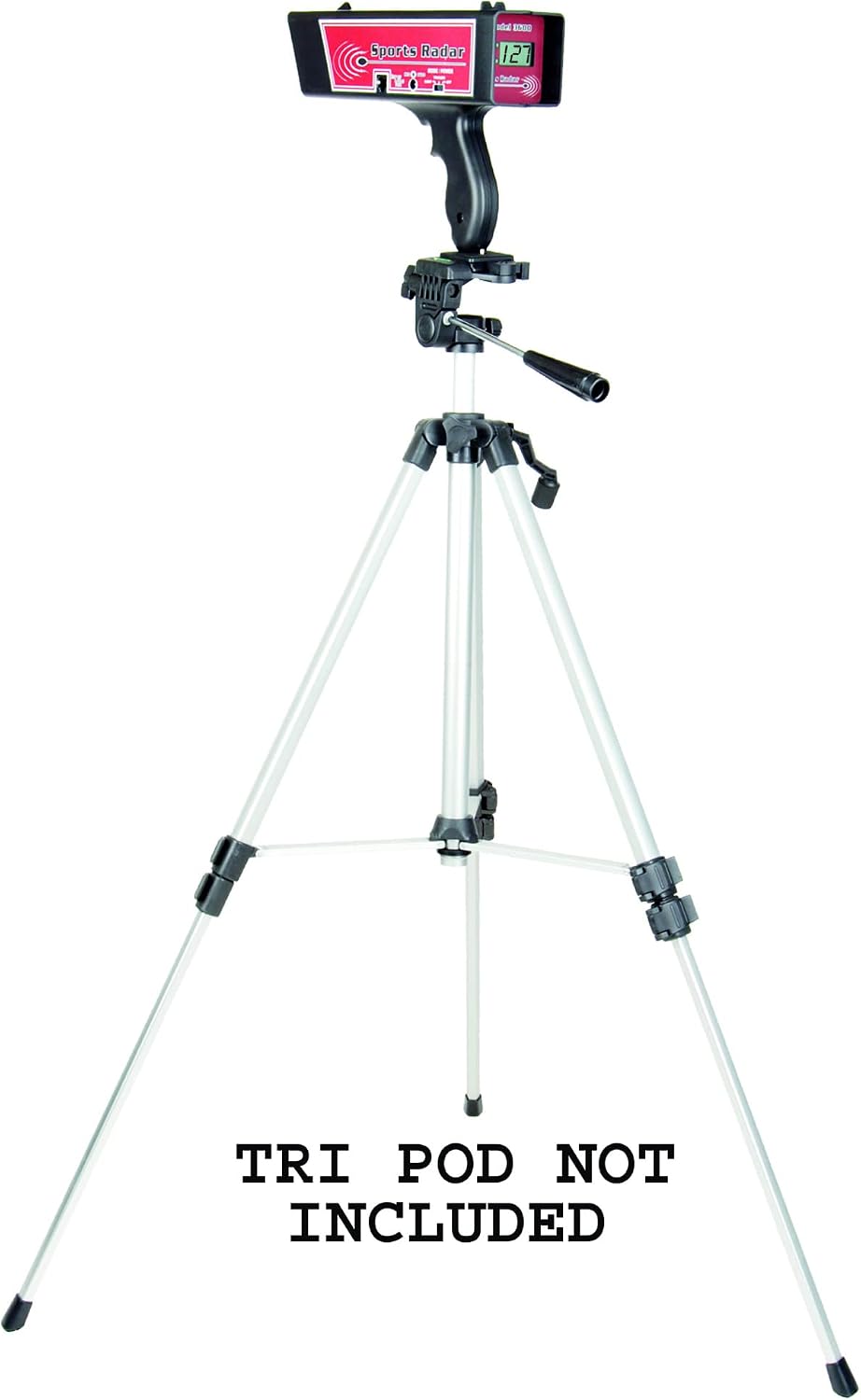
Sports Radar SR3600-LS Low Speed Radar Gun
The Sports Radar SR3600-LS is the low speed version of the SR3600 radar gun, built for baseball and softball programs that need to measure things moving too slowly for an ordinary speed gun. It reads from 4 MPH up to 200 MPH, so the entire pitching range is still covered, but the useful part is the bottom: tee ball and coach pitch stations, underhand toss drills, slow pitch arcs, rolled balls in fielding work and adaptive programs where the throw is gentle by design.
Everything else is the SR3600 you already know. Same 60 foot reading range on a ball, same trigger and continuous modes, same RadarDataPort for driving a remote LED display, same 1/4-20 tripod thread, same made in the USA build. The low speed floor is a factory modification of the standard gun rather than a different instrument, which is why it behaves identically once the ball is moving at normal speed.
What the Low Speed Floor Actually Buys You
A standard SR3600 starts reading at 10 MPH. Every pitch thrown in a baseball or softball game is well above that, so for pure pitching work the base gun is the right purchase and the LS adds nothing. The band the LS opens up is 4 to 10 MPH, and it matters in specific places.
Tee ball and coach pitch speed stations are the clearest example. A 6 MPH lob from an eight year old is a real number to that kid, and a base gun simply shows nothing. Soft toss and front toss drills fall in the same window when the feeder is close and easy. Slow pitch softball deliveries arc in slowly enough that the bottom of the range matters. Fielding drills built on rolled or bounced balls sit down there too, and so does most adaptive and wheelchair sport work, where the point of the session is control rather than velocity.
The honest test is simple. If the slowest thing you will ever point it at is a pitch, buy the standard SR3600. If the slowest thing is a toss, a roll or a young arm barely getting the ball there, the LS is the version that will not leave you looking at a blank display.
Trigger and Continuous Modes on the SR3600-LS
Trigger mode gives a reading on demand. Point at the ball's path, pull, release, and the speed appears on the three digit display. It is the mode for a coach working one on one with a pitcher, or a parent charting a bullpen from the side.
Continuous mode is the hands free mode and the reason one person can run a station alone. The gun reads by itself with nobody holding it, so it can sit on a tripod at the end of a tee ball lane all afternoon while a single volunteer manages the line. The 52 inch tripod threads onto the standard mount underneath the housing, and a wall or vehicle power adapter keeps a busy station running without touching the battery door.
Speeds display in MPH or KPH, chosen by holding the trigger while the gun powers on. The setting persists, so it is a one time decision.
Range, Position and Getting an Honest Number
Reading range on a ball is 60 feet in typical conditions, unchanged from the standard gun. That covers a tee ball lane, a cage, a bullpen, a soft toss station or a booth from a comfortable working distance, and it is short of what you would need to sit behind a backstop and read a full game.
Alignment is the thing that decides whether the number is right. Radar measures the portion of the ball's motion travelling directly toward or away from the gun, so an operator standing well off to the side reads low. This matters more at slow speeds than fast ones, because a few miles per hour lost to a bad angle is a large share of an 8 MPH toss. Set up behind or in front of the ball's path rather than beside it, keep the gun near the height of the ball, and the readings hold together across a session.
The Data Port and Remote Displays
The RadarDataPort is an RS232 serial output made for Sports Radar equipment. It sends readings to a red LED speed display so a whole line of players at a camp station or a fundraiser booth can see the number without crowding the gun, and it feeds the speed acquisition software on a Windows computer through the Sports Radar adapter that ships with that package.
The port is for Sports Radar displays and adapters only. Running a plain serial cable from the gun to a computer can damage both, so the adapter is not optional. The same port is what lets a facility grow a hand held gun into a permanent display setup later without replacing the radar.
Who This Radar Gun Is For
The SR3600-LS fits youth baseball and softball organizations, tee ball and coach pitch programs, camps that run speed stations for every age group, adaptive sports programs, and training facilities that want one gun capable of reading both a high school fastball and a six year old's toss. It also serves facilities that need to measure slow moving equipment on site and want the data port to drive a large warning display.
It is not the right choice if you only ever clock pitching, where the base SR3600 does the same job. It is also not the gun for reading from a distance or for pitch and plate differential; the SR3800 reads a baseball to 150 feet and reports both speeds from one throw, and the SR3800-LS combines that pitch and plate capability with a 4 MPH floor. For measuring things slower than a walking pace, the SR3800-ULS resolves to half a mile per hour but tops out at 25 MPH and cannot read a pitch at all.
Training Applications
Age group speed stations are the most common use. One gun covers a camp that runs tee ball through varsity on the same afternoon, because the low end reads the little kids and the top end still handles the oldest arm on the field.
Toss and drill feedback works well here. Front toss, underhand flips and machine fed drills all have a speed, and putting a number on the feed is how a coach keeps a drill consistent from day to day instead of guessing at it.
Slow pitch softball arcs read cleanly with the low speed floor, so a rec league or a coach working on delivery consistency gets usable feedback instead of a blank screen.
Return to throwing and adaptive programs need the bottom of the range more than anyone. Early progressions are deliberately soft, and being able to chart 5 and 6 MPH tosses climbing week by week gives an athlete something visible to hold on to.
Fielding drills built on rolled grounders and short hops can be measured too, which is a straightforward way to keep a machine or a coach's feed honest across a long practice.
Sports Radar SR3600-LS Low Speed Radar Gun Specifications
- Speed range: 4 to 200 MPH, also selectable in Km/H
- Resolution: 1 MPH
- Reading range on a ball: 60 feet typical
- Radar band: X band, 10.525 GHz
- Display: 3 digit LCD
- Modes: trigger and continuous hands free operation
- Power: two standard 9V batteries, or external DC through the power jack
- Data output: RadarDataPort RS232 serial, for Sports Radar displays and adapters
- Mounting: standard 1/4-20 tripod thread
- Origin: made in the USA
- Warranty: 1 year limited
What's Included
- SR3600-LS low speed radar gun
- Instruction manual
Batteries are not included, and the gun needs two 9V cells to run. Sold separately: the hard carry case, the 52 inch tripod, wall and vehicle power adapters, the 65 MPH tuning fork, remote LED displays and the computer software package.
Frequently Asked Questions
What does the LS version add over the standard SR3600?
Only the bottom of the speed range. The floor drops from 10 MPH to 4 MPH. Reading range, modes, the data port, the tripod mount and the housing are all the same, so this is a purchase decision about slow targets and nothing else.
Does it still read a high school fastball?
Yes. The low speed floor is added to the range rather than traded for it, so the top end is unchanged and pitching speeds read normally.
Will it work for fastpitch softball?
Yes. Fastpitch deliveries sit comfortably inside the range on either version of this gun. The reason to choose the LS for a softball program is the slower stuff around the edges of practice, such as coach pitch, toss drills and slow pitch arcs.
Are batteries included?
No. It takes two 9V batteries, which are sold separately, or you can run it from a wall or vehicle adapter through the external power jack.
Can one person run a station with it?
Yes. Continuous mode reads without anyone holding the gun, so a tripod at the end of the lane and one volunteer is a working setup. Adding a remote LED display means players see their own number without walking over to the gun.
Does it show pitch speed and plate speed?
No. That is a feature of the SR3800 family. If you want pitch and plate readings together with a low speed floor, the SR3800-LS is the model that does both.
How do I check that it is still reading correctly?
Strike the 65 MPH X band tuning fork and hold it in front of the gun; the display should read 65. It is a verification check, not a calibration, since there is no user calibration on these guns.