


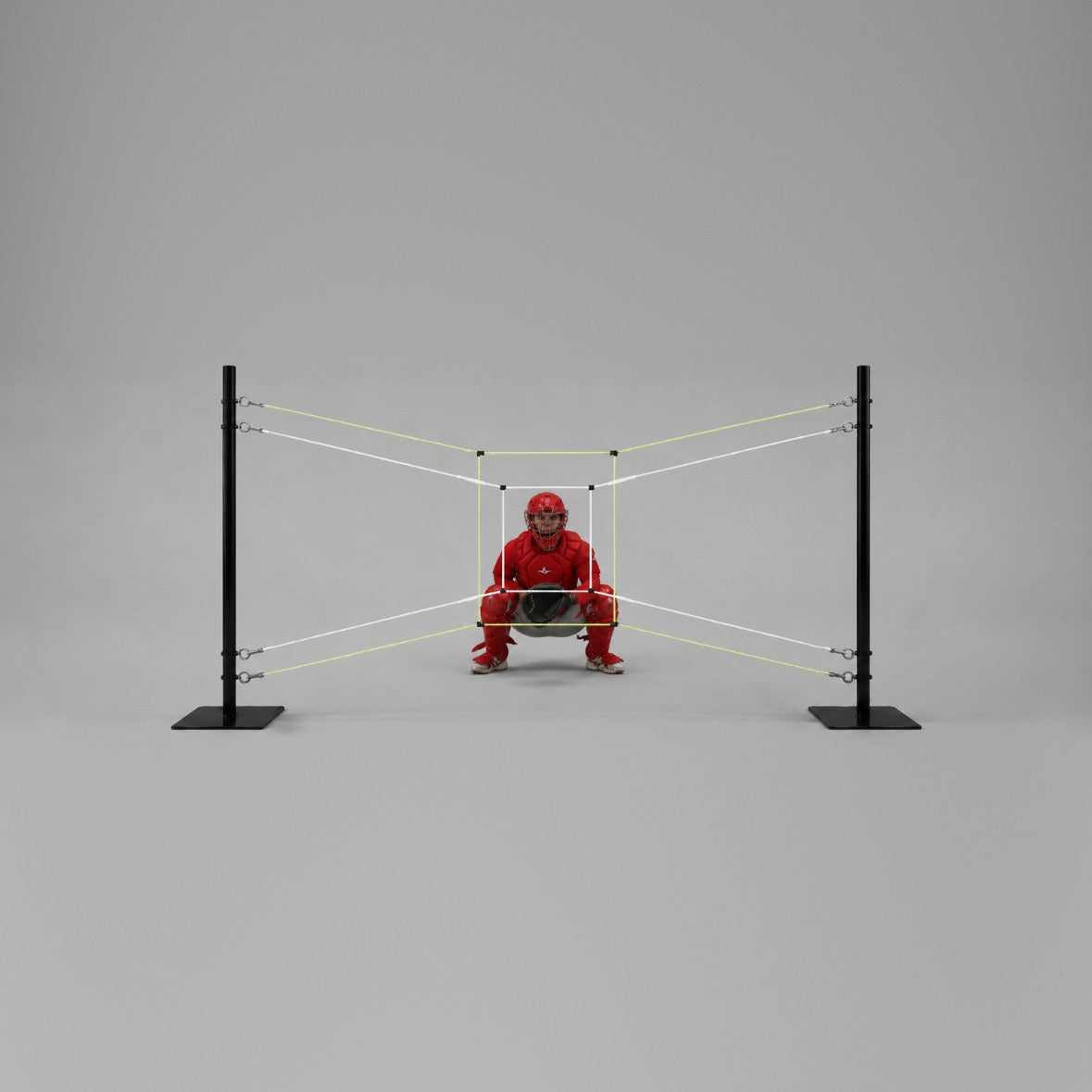
Muhl Shadow Zone Pitching Target
The Muhl Shadow Zone Pitching Target is a string strike zone built to teach baseball pitchers to live on the edges. Two upright poles hold two adjustable string zones: an inner zone that marks the strike zone and an outer zone that marks the shadow band around it. Every bullpen pitch gets an instant, visible answer - in the heart, on the edge, or off the plate. It is in use in professional baseball bullpens, including the Houston Astros organization, and it works just as well for high school, college and travel ball pitchers who want every bullpen session to have a purpose.
What the Shadow Zone Is and Why Pitchers Train It
The shadow zone is the narrow band that straddles the border of the strike zone, roughly one baseball width inside the edge and one baseball width outside it. Pitches in that band are the hardest for a hitter to judge. Just inside the line is a strike he has to protect against. Just outside is a ball he is tempted to chase. That band is where called strikes, chase swings and weak contact come from, which is why pitching coaches talk about owning the black and making the hitter hit your pitch.
Most baseball pitching targets reward the middle of the zone. The Shadow Zone shows the pitcher both lines at once, so the goal of the session changes from "throw a strike" to "hit the edge you picked."
Two Adjustable String Zones, One Clear Picture
White strings outline the inner strike zone. Yellow strings frame a larger rectangle around it and mark the outer edge of the shadow band. Because both zones are string rather than a solid frame, the pitcher, the catcher and the coach can all see exactly where the ball crossed, and the pitch carries through the open frame to the catcher.
Both zones adjust in height and width, so the target can be set for the hitter you are pitching to rather than one fixed box. Lower and shorten the inner zone for a smaller hitter, raise it for a tall one, or tighten the gap between the two zones to make the edge band harder to hit as a pitcher's command improves.
Proven in Professional Bullpens
The Shadow Zone has been put to work in the Houston Astros organization. Sean Buchanan, pitching coach for the Triple-A Sugar Land Space Cowboys and assistant pitching coordinator for the Astros farm system, credits it with moving his staff "from near the bottom to the top in accuracy," and says no pitcher on his staff throws a bullpen without it.
The two poles stand on flat base plates and set up on either side of home plate, so the same frame fits a professional bullpen, a college facility, an indoor cage or a backyard mound. Nothing sits between the pitcher and the catcher except string, so a normal catch session runs the way it always does, with feedback added to every pitch.
Train Against the ABS Strike Zone
The automated ball-strike (ABS) challenge system now used in Major League Baseball calls a flat, rectangular zone. It is 17 inches wide, the width of home plate, with the top set at 53.5 percent of the batter's height and the bottom at 27 percent, measured at the middle of the plate. A string zone is also a flat rectangle, so the inner zone of the Shadow Zone can be sized to that same box. Pitchers can practice against the zone that will actually be called instead of a zone they have to imagine.
How to Use the Shadow Zone in a Bullpen
- Paint the corners: call a corner before each pitch and count how many finish in that corner of the shadow band.
- Work the top and bottom: elevate fastballs to the top edge and bury breaking balls at the bottom edge instead of living in the middle.
- Own the black: track how often a pitch lands between the white and yellow strings, the 50/50 area where called strikes and chases happen.
- Expand with two strikes: aim just outside the white strings but inside the yellow ones, the pitch a hitter has to chase.
- Score the session: give points for the edge band, fewer for the heart, none outside the yellow strings, and chart the score week to week.
The Shadow Zone is an open frame, so it needs a catcher or a backstop behind it. For solo work, set it in front of a 2-Sport Catcher 4x6 Backstop with Frame.
Who the Shadow Zone Pitching Target Is For
- High school and college baseball pitchers who already throw strikes and now need to throw quality strikes
- Pitching coaches who want an objective read on command instead of calling it by eye
- Training facilities and team bullpens where several pitchers throw in the same session
- Travel ball pitchers preparing for showcases, where command is what scouts and coaches notice
Younger pitchers who are still learning to throw strikes consistently may be better served first by a pocket-style target that catches the ball, such as the Zone-In Pitching Target or the 9 Hole Pitching Target. The full range is in our pitching targets collection.
Muhl Shadow Zone Pitching Target Specifications
- Type: string strike zone pitching target
- Sport: baseball
- Uprights: 2 poles on flat base plates
- Zones: 2 string zones - inner strike zone (white) and outer shadow zone (yellow)
- Adjustment: both zones adjust in height and width
- Setup: freestanding on either side of home plate; use with a catcher or in front of a backstop
- Brand: Muhl
What Is Included
- 2 upright poles with base plates
- 2 string strike zones (inner and outer)
Frequently Asked Questions
What is the shadow zone in baseball?
It is the band along the border of the strike zone, about one baseball width inside and outside the edge. Pitches there are the hardest to judge, so they produce the most called strikes, chases and weak contact. The Shadow Zone target marks both sides of that band with string.
Does the Shadow Zone stop the ball?
No. The ball passes through the open frame, so use it with a catcher or set it in front of a backstop or net.
Can I set it to the MLB ABS strike zone?
Yes. Set the inner zone 17 inches wide, then set the bottom at 27 percent and the top at 53.5 percent of the hitter's height. For a 6 foot hitter, that is a bottom edge of about 19 1/2 inches and a top edge of about 38 1/2 inches.
Is it only for professional pitchers?
No. It is used in pro bullpens, but it suits any baseball pitcher who can already throw strikes and wants to start commanding the edges. High school, college and travel ball pitchers get the most out of it.
Can I use it indoors?
Yes. The poles stand on their own base plates, so it sets up on turf, in a cage or on an indoor pitching lane as well as in an outdoor bullpen.
