


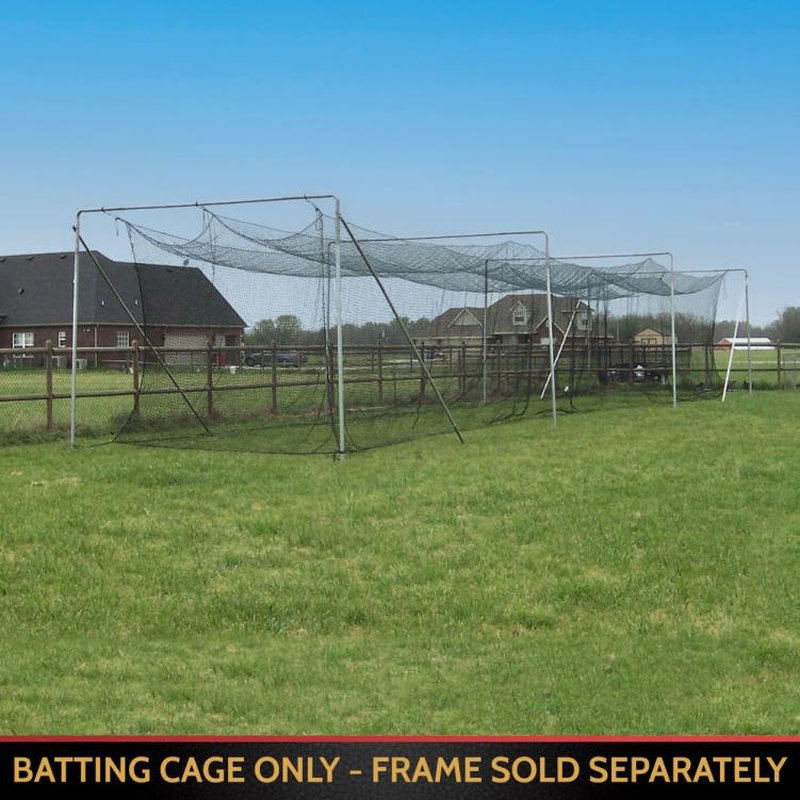
About the Cimarron Batting Cage Nets - Twisted Poly, #24 to #84
Cimarron Batting Cage Nets are baseball and softball cage nets made from twisted, knotted black poly twine, sold as the net only for hanging on your own frame or cable system. They come in five net weights, from the #24 for backyard hitters up to the #84 for high-volume training facilities, and in standard sizes from 30 to 70 feet long. Every net has a 4-foot overlapping entry door, a full rope border and three top ropes that run the length of the cage.
Two choices set up your order: the net weight, which is how heavy the twine is, and the net size, which has to match your frame or building. The guides below walk through both.
Quick Answers
- What you get: one batting cage net with a built-in entry door. The frame, poles and cable are sold separately.
- Net weights: #24, #42, #45, #60 and #84. A higher number means thicker twine and a heavier net.
- Most common choice: the #42, a 2.5 mm twine used on both home and commercial cages.
- Sizes: 14 stock sizes, listed length x width x height. Not every size is made in every net weight.
- Delivery: #24, #42 and #45 nets ship by standard parcel. #60 and #84 nets ship on a pallet by truck freight.
Which Net Weight Do You Need?
The number on a cage net describes the twine. The higher the number, the thicker the twine, the heavier the net and the more daily hitting it is built for. Pick the weight by how hard and how often the cage will be used.
- #24 Backyard: the lightest net in the line, made for young baseball and softball players practicing at home. It suits indoor and outdoor home cages and comes in the shorter 30, 40, 50 and 60 foot lengths with a 10-foot ceiling, as well as 55 and 70 foot sizes.
- #42 Standard: 2.5 mm twine, the most common twine thickness for batting cages. It fits home cages indoors or out and indoor commercial cages, and it comes in the widest range of sizes, including 35-foot half cages and 14-foot ceilings.
- #45 Commercial: 2.7 mm twine for players and teams who hit every day. It is the heaviest net in the line that still ships by standard parcel, and it suits outdoor home cages and indoor or outdoor commercial cages.
- #60 Professional: 3.0 mm twine for teams and organizations that run a cage hard all season, indoors or outdoors. Because of its weight it ships by truck freight, and it should hang from a 1/4 inch cable kit or a 2 inch commercial frame.
- #84 Heavy-Duty: 4.0 mm twine, the heaviest tunnel in the line, for high-volume training facilities. It ships by truck freight and should hang from 3 inch steel poles or 1/2 inch steel cable. Have a structural engineer review the building or frame before you install a net this heavy.
Which Cimarron Batting Cage Net Size Fits Your Space?
Every size is listed length x width x height in feet. If you already own a frame, measure it and pick the matching net. If you are planning a new cage, start with the length your space allows.
- 30, 40, 50 and 60 foot nets (12 feet wide, 10 feet high): backyard sizes, made in the #24 weight. The 10-foot ceiling keeps the cage low enough for most yards.
- 35 foot nets (12 or 14 feet wide, 12 or 14 feet high): half cages for tight spaces, garages and tee or soft toss work, made in the #42 weight.
- 55 foot nets (12 or 14 feet wide, 12 feet high): a mid-length tunnel for lots that cannot take a full 70 feet. Made in every net weight; the #84 comes only in the 14-foot width.
- 70 foot nets (12 or 14 feet wide, 12 feet high): the full-length tunnel, with room for a pitching machine or a live arm behind a screen at baseball distance. Made in every net weight; the #84 comes only in the 14-foot width.
- 70 foot nets with a 14-foot ceiling (12 or 14 feet wide): the tallest stock size, made in the #42 weight.
A 14-foot width gives a hitter more room to move around the plate and leaves more space between the batter and the side netting than a 12-foot width.
Twisted, Knotted Twine That Takes Daily Hitting
Batted balls hit the same panels of a cage over and over, so the twine and the knots do the real work. Each Cimarron net is built from twisted poly twine that is knotted at every intersection, which holds the mesh square and keeps a hard-hit baseball or softball from spreading the opening. The polymer blend resists abrasion, so the net holds up where balls strike most often and where the netting rubs against the frame.
Built to Stay Outside
An outdoor cage sits in sun and rain for months at a time. The twine is UV treated to slow the sun damage that makes untreated netting brittle. It does not absorb water and it does not shrink, so the net keeps its size and hangs the same way season after season instead of pulling tight on the frame after wet weather.
Entry Door, Rope Border and Top Ropes
You step into the cage through a 4-foot wide overlapping entry door. The two panels overlap, so the opening closes behind you and balls stay inside. On the #24, #45 and #84 nets the door is on a long side of the cage. On the #42 and #60 nets it is on an end.
A full rope border is stitched around the net, which gives you a strong edge to tie off and lets you square the net to the frame. Three top ropes run the length of the cage to carry the weight of the ceiling and keep the middle from sagging.
Who Cimarron Batting Cage Nets Are For
- Families building a backyard baseball or softball cage on a pole frame.
- Travel teams, high schools and colleges replacing a worn net on a frame they already own.
- Indoor training facilities hanging tunnels from a cable system.
- Anyone whose frame is still sound but whose netting has holes, sun damage or sag.
How Do You Hang a Batting Cage Net?
The net hangs from the rope border and the three top ropes. On an outdoor pole frame, tie the top ropes and border to the frame, then square the corners. Indoors, clip the top ropes to an overhead cable system such as the Indoor Batting Cage Cable Kits or the Premier Batting Cage Cable Kits. Let the bottom of the net rest on the ground so balls cannot roll out underneath.
Hang a backstop behind the plate to take the wear where pitches land. A rubber batting cage backstop protects that panel and extends the life of the net. Keep a net repair kit on hand to close small holes before they spread.
Cimarron Batting Cage Nets Specifications
- Type: baseball and softball batting cage net (tunnel), net only
- Material: twisted, knotted poly twine, UV treated
- Color: black
- Net weights: #24, #42 (2.5 mm twine), #45 (2.7 mm twine), #60 (3.0 mm twine), #84 (4.0 mm twine)
- Entry: one 4-foot wide overlapping door
- Support: full rope border, three top ropes running the length
- #24 sizes: 30x12x10, 40x12x10, 50x12x10, 60x12x10, 55x12x12, 55x14x12, 70x12x12, 70x14x12
- #42 sizes: 35x12x12, 35x14x12, 35x12x14, 35x14x14, 55x12x12, 55x14x12, 70x12x12, 70x14x12, 70x12x14, 70x14x14
- #45 sizes: 55x12x12, 55x14x12, 70x12x12, 70x14x12
- #60 sizes: 55x12x12, 55x14x12, 70x12x12, 70x14x12
- #84 sizes: 55x14x12, 70x14x12
- All sizes are length x width x height in feet
- Delivery: #24, #42 and #45 by standard parcel; #60 and #84 on a pallet by truck freight
Frequently Asked Questions
Does the net come with a frame?
No. This is the batting cage net only. The frame, poles, cable and hardware are sold separately.
What does the number on a batting cage net mean?
It describes the twine. A higher number means thicker twine and a heavier, longer-wearing net. In this line the #42 uses 2.5 mm twine, the #45 uses 2.7 mm, the #60 uses 3.0 mm and the #84 uses 4.0 mm.
Which net weight is best for a backyard batting cage?
The #24 is made for young players hitting at home, and the #42 is the step up for older or stronger hitters and for cages that get used most days. The #45 suits an outdoor home cage that sees daily team-level use.
Can I use these nets for both baseball and softball?
Yes. Every net weight is made for baseball and softball hitting.
Will this net fit the frame I already have?
Match the net to the inside dimensions of your frame, length x width x height. A net that is slightly smaller than the frame hangs cleanly inside it; a net larger than the frame will bunch on the ground.
Where is the door on the net?
Each net has one 4-foot overlapping door. It is on a long side on the #24, #45 and #84 nets and on an end on the #42 and #60 nets.
See every size and brand we carry in batting cage nets.
