


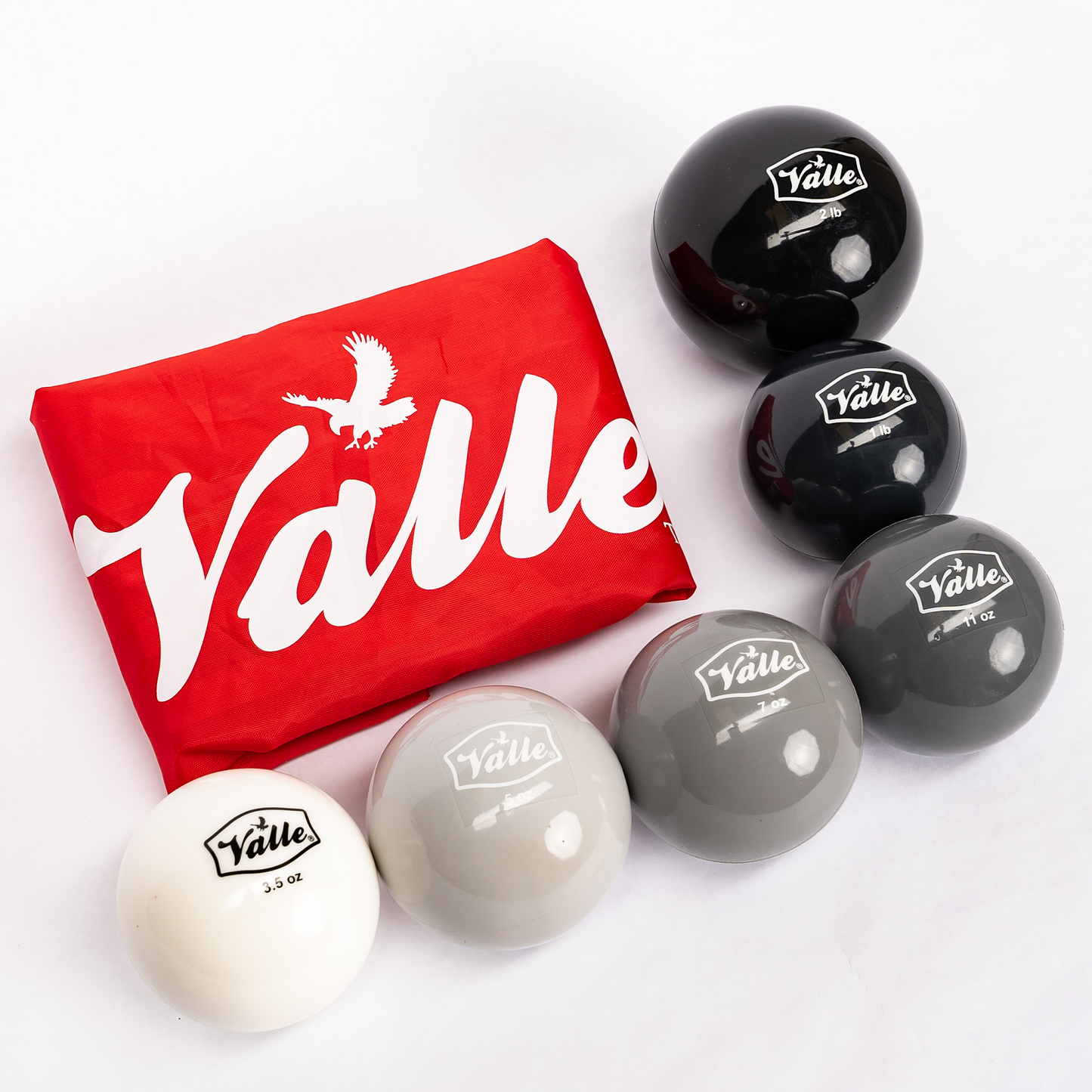
Valle Throwing Plyo Set
The Valle Throwing Plyo Set is six weighted plyometric balls, from 3.5 ounces up to 2 pounds, for the overload and underload throwing work that has become standard in baseball and softball arm programs. The range is the product: one ball lighter than a baseball, one about the same, and four progressively heavier, so a full session of warm up, strength work and recovery runs off a single set.
What Overload and Underload Training Does
The principle is simple. Throwing something heavier than a baseball forces the arm and the whole kinetic chain to work harder and slower, which builds strength and exposes mechanical faults that a light ball lets a player hide. Throwing something lighter lets the arm move faster than it can with a baseball, training the nervous system for speed. Alternating between the two is what plyo work is for, and it is why a set beats a single weight.
The 3.5 ounce ball is the underload end, lighter than a regulation baseball. The 5, 7 and 11 ounce balls sit around and just above game weight, which is where most of the mechanical work happens. The 1 pound and 2 pound balls are for close-range drill work against a wall, not for long throws, and that distinction matters more than any other instruction on this page.
Six Weights: 3.5 oz, 5 oz, 7 oz, 11 oz, 1 lb, 2 lb
A single weighted ball gives a player one stimulus. A set lets a coach build an actual progression: warm the arm with the lighter balls, do positional and drill work with the middle weights, finish heavy and close, then come back down. It also lets one set serve a whole roster, because a fourteen year old and a college pitcher are not doing the same session.
The balls are made from a pliable material, which does two useful things. It absorbs the impact so they can be thrown into a wall from a few feet away, and it deforms visibly on contact, so a player and a coach can see the impact rather than guess at it.
Choosing Weights Within the Set
A common mistake is treating the heaviest ball as the goal. It is not; it is the most specialised tool in the bag. The 2 pound ball is for short, controlled drill work against a wall, where the point is feeling the sequence of the throw rather than producing velocity. The 1 pound ball does the same job with a little more speed.
The middle weights, 7 and 11 ounces, are where most of a session lives, because they are close enough to a baseball that the mechanics stay recognisable while the load is meaningfully higher. The 5 ounce ball is essentially game weight and is useful for connecting the drill work back to a normal throw. The 3.5 ounce underload ball comes last in most sessions, when the arm is warm and ready to move fast.
Who This Plyo Set Is For
Pitchers are the obvious audience, but position players get as much out of it. Any baseball or softball player doing a structured arm care programme, any high school or travel programme running a throwing progression, and any player rehabbing volume after a layoff can use these. Coaches tend to buy one set per throwing group rather than per player, because the balls are shared through a station.
It is not a beginner tool. A player who has not yet built a repeatable throwing motion should build that first; weighted work amplifies whatever mechanics are already there, good or bad.
How to Use the Valle Throwing Plyo Set
Warm up first with the lighter balls at short distance, throwing into a wall or a net rather than to a partner. Work through pivot pickoffs, rollovers and reverse throws, which are the standard plyo drill family, moving up in weight as the arm gets loose. Keep the heavy balls close to the wall and the light balls for the faster, longer work.
Volume beats intensity here. Two or three short sessions a week, inside a programme, does far more than one long session, and the heavy balls in particular are easy to overdo. Finish with regular baseballs so the arm reconnects the feel to a game ball.
Note plainly: this set does not include a written programme. Valle supplies the balls, not the protocol, and a plyo progression should come from your pitching coach or trainer rather than improvised.
Valle Throwing Plyo Set Specifications
- Type: weighted plyometric throwing balls, set of six
- Weights: 3.5 oz, 5 oz, 7 oz, 11 oz, 1 lb, 2 lb
- Material: pliable, deforms visibly on impact
- Use: overload and underload throwing, warm up, arm strength, active recovery
- Includes: drawstring carrying bag
- Sport: baseball and softball
What Is Included
Six weighted plyo balls and a drawstring carrying bag. No exercise programme or instruction sheet is included.
Frequently Asked Questions
Can I throw these to a partner?
The lighter balls, yes, at short distance. The 1 pound and 2 pound balls are for close work into a wall or a net and should not be thrown to a person or over any distance.
What age can start using plyo balls?
Generally high school age and up, and only inside a structured programme. Younger arms are better served by throwing volume and clean mechanics.
Will these add velocity?
Weighted ball work is used in velocity programmes, but it is one input among many and it works through a progression rather than on its own. Treat it as arm strength and mechanics work, not a shortcut.
Do they come with a workout plan?
No. The set is the six balls and a bag; the programme should come from your coach or trainer.
Can these be used indoors?
Yes, into a suitable wall or net. The pliable material is what makes close-range indoor work possible.
