


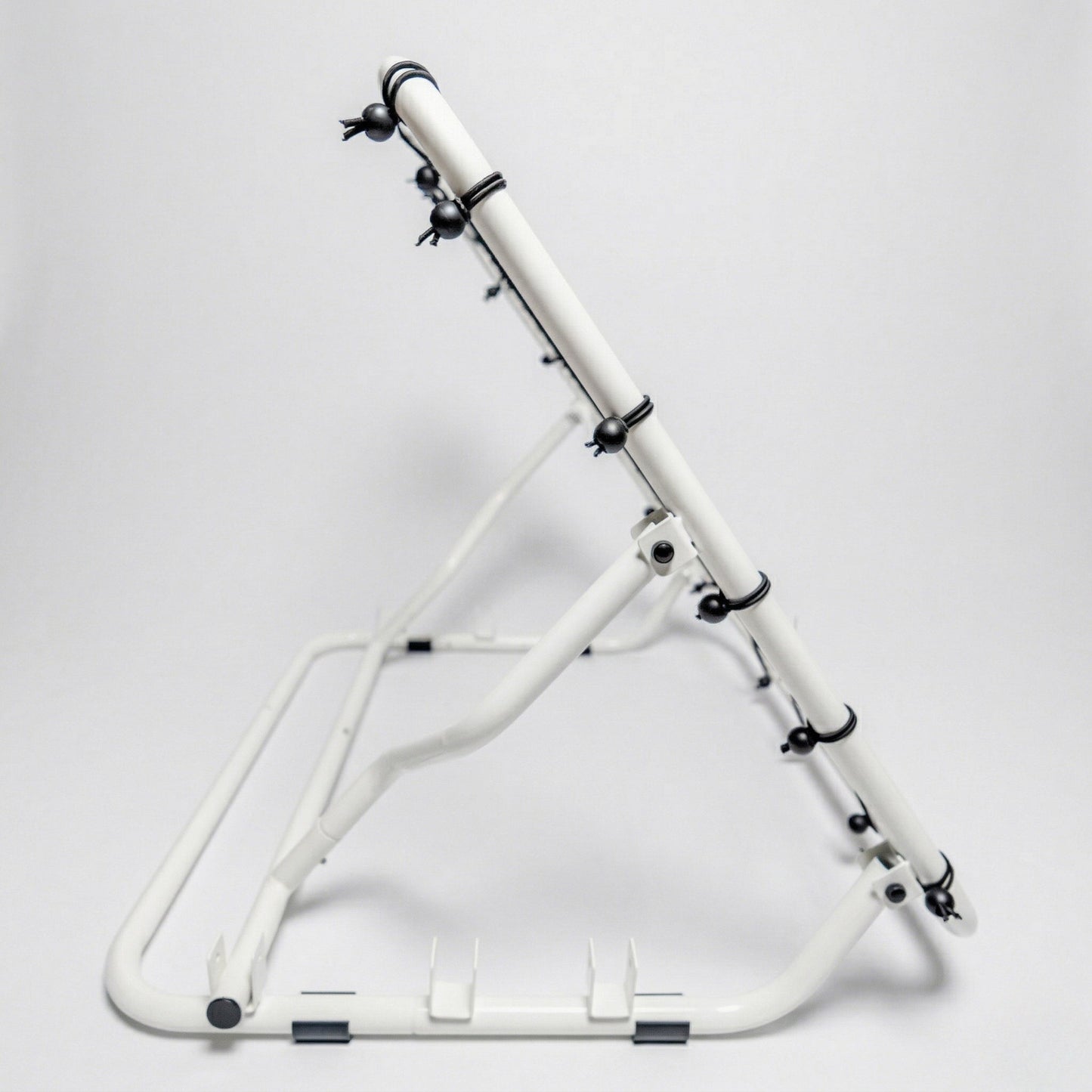
Valle Pitchback Rebounder
The Valle Pitchback Rebounder is a 28 by 28 inch rebound net for baseball and softball players who need reps without a partner. Throw at it and the ball comes back, which sounds trivial until you count how much of a player's development depends on having someone else available. It turns a driveway, a garage or an outfield corner into a place where fielding, throwing accuracy and reaction work can happen alone.
The Netting Is the Difference
Most rebounders are built with an open net square, which is fine for a regulation baseball and useless for anything smaller. Valle deliberately built this one with smaller squares so it pairs with their 8 inch small training balls, which pass straight through a standard rebounder. That single decision is what makes this the rebounder to own if you train with undersized balls.
The netting is high tension, so the return is quick and consistent rather than a dead flop. A rebounder that returns the ball weakly trains nothing, because the fielder is never under any time pressure. This one gives back roughly what you put in, which is what makes reaction work possible.
What You Can Actually Train With It
Fielding is the obvious one. Throw low into the net and it comes back as a ground ball or a short hop, and because you control the throw you control the rep, which is more repeatable than a partner with a fungo. Throw higher and it comes back as a line drive for reaction work.
Throwing accuracy is the underrated use. A 28 inch target is small enough that hitting it consistently from thirty feet is a real skill, and the feedback is instant: miss the target and the ball does not come back. Pitchers use it for command work, infielders for the accuracy half of the double play feed.
Reaction and quick hands work is where it earns a place next to the training gloves. Stand close, throw hard, catch what comes back, and the interval between throw and catch is short enough that the hands have to be ready rather than getting ready.
What It Replaces, and What It Does Not
A rebounder replaces a throwing partner for the repetitive parts of practice, which is most of them. It does not replace a coach with a fungo, because it cannot vary the ball the way a bat can, and it cannot put a ball where you are not expecting it. Used honestly it is a volume tool: it lets a player take four hundred controlled reps in a week that would otherwise not happen at all.
Space needed is modest. A flat area roughly ten to twenty feet deep is enough for most of the work, which fits a driveway, a garage bay or a corner of a yard. That is the practical argument for it over a full net setup, which needs room most players do not have at home.
Who This Rebounder Is For
Players who train alone are the core: a high school infielder in a driveway, a pitcher working command in a back yard, a college player home for a break. Programmes use them as station equipment because a rebounder station runs itself while a coach works elsewhere.
At 28 by 28 inches it is a compact, single-player tool rather than a full field screen. If you want something to catch batted balls or to protect a pitcher, that is a different piece of equipment; the field screens and nets range covers that job.
How to Set Up and Use the Valle Pitchback Rebounder
Set it on flat ground with the frame square to you and start close, around ten to fifteen feet, throwing at maybe half effort until you learn how the net returns. Every rebounder has its own bounce and the first few minutes are calibration.
For ground ball work, aim low on the net and set your feet as though the ball were coming off a bat. For reaction work, move closer and aim higher. For command work, pick a spot on the net and throw at it from a fixed distance, counting hits out of ten rather than throwing aimlessly.
Bring it inside or under cover when you are done. Netting and frames last far longer out of the weather, and a rebounder left out all season is a rebounder replaced next season.
Valle Pitchback Rebounder Specifications
- Type: rebound net for fielding, throwing and reaction training
- Dimensions: 28 in x 28 in
- Netting: high tension, tight square pattern sized to return small training balls
- Frame: durable steel frame construction
- Use: solo fielding reps, throwing accuracy, reaction and quick hands work
- Sport: baseball and softball
- Pairs with: Valle small training balls and the undersized training gloves
What Is Included
One rebounder, frame and netting. Balls are not included.
Frequently Asked Questions
Will small training balls come back off it?
Yes, and that is the point of the design. The net squares are deliberately smaller than a standard rebounder's so an 8 inch ball rebounds instead of passing through.
How far back should I stand?
Start around ten to fifteen feet and adjust. Closer makes it a reaction drill, further makes it a fielding and accuracy drill.
Can I use a regulation baseball?
Yes. The tighter netting handles a regulation baseball as well as a small training ball.
Is this big enough for a catcher or a pitcher's screen?
No. At 28 inches square it is a training rebounder for one player, not a protective screen.
Can it stay outside?
Better not to. It is built to be durable, but netting and frames both last longer stored out of the weather.