


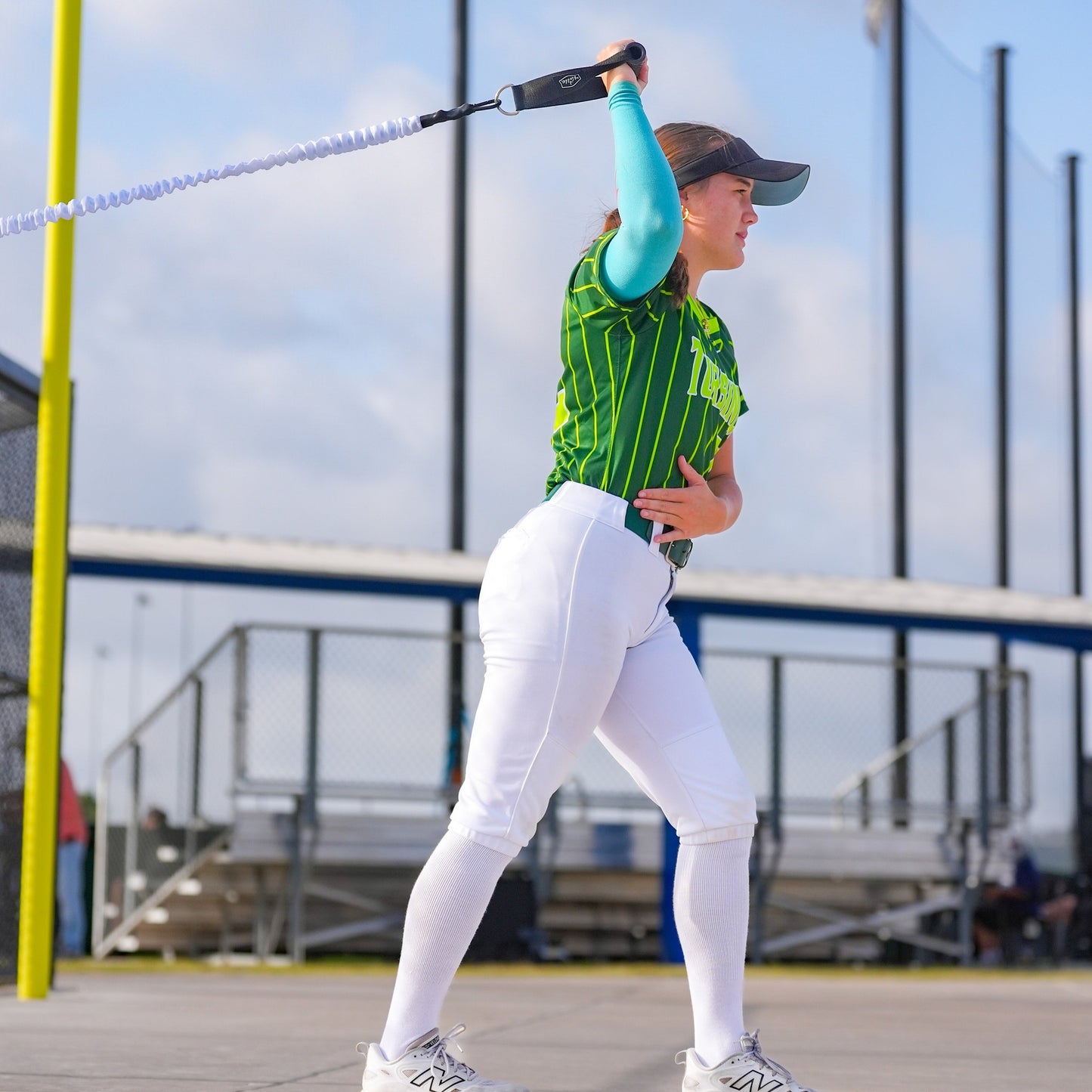
Valle Arm Bands
Valle Arm Bands are resistance bands built for the shoulder and arm work every throwing athlete in baseball is supposed to be doing and most skip. They come in three resistances, light, medium and heavy, and the details that separate them from a generic band are the interchangeable handle, the protective band sleeve and the carabiner clip that makes setup take seconds rather than minutes.
What Band Work Is Actually For
Arm care bands do three jobs across a baseball season. Before throwing they wake the shoulder up, so the first throw is not the warm up. After throwing they help the arm come down, which is where most recovery is won or lost. And across a winter they build the small stabilising muscles that a throwing motion depends on and that nothing else in the weight room trains well.
None of that requires heavy resistance, which is why the light band is not the beginner option. Most arm care protocols are high repetition and low load, and a band that is too heavy turns a shoulder exercise into a back exercise. Heavier bands are for players with a base already built, or for the pulling and rowing patterns in a fuller programme.
Interchangeable Handles and Wrist Straps
The set includes both a traditional handle and wrist straps, and they swap on the same band. That sounds minor until you run a protocol. Handles are better for rows, pull-aparts and anything where you are gripping and pulling. Wrist straps take the hand out of it entirely, which is what you want for external and internal rotation work, because a player who is squeezing a handle is recruiting the forearm instead of the rotator cuff.
The heavy duty carabiner clip is the other practical detail. It anchors to a fence, a net frame or a pole in seconds, which matters when the arm care block is eight minutes between a bullpen and a bus.
The Band Sleeve, and Why Bands Fail
Bands do not usually wear out gradually. They dry out, develop a weak point, and then snap, often at full stretch and often across someone's face. The Valle bands include a sleeve that covers the band to protect against drying out and overstretching, which addresses the failure directly rather than telling you to inspect the band and hope.
It is a small piece of kit that meaningfully changes how long a band lasts in a bag that lives in a car through a summer.
Who These Arm Bands Are For
Pitchers first, but every position player who throws should own a set. High school and travel programmes buy them per player because arm care is individual and daily. They also suit a player training at home, since the whole set anchors to a fence and packs into the carrying bag.
Choose light for daily pre-throwing and post-throwing routines and for younger players. Medium is the common all-round choice for a high school arm. Heavy is for a mature, conditioned arm or for the strength end of a programme rather than the warm up.
Why This Set Survives a Season in a Bag
Arm care equipment fails for boring reasons. A band left in a hot car dries out. A handle that will not swap means half the protocol gets skipped. A band with no anchor gets tied around a fence post at whatever height happens to be convenient, which changes the exercise.
This set is built around those failures rather than around the band itself. The sleeve protects the rubber, the carabiner fixes the anchor height in seconds, the handle and wrist straps cover both halves of a protocol, and the bag keeps the parts together so nothing is missing at the field. That is the difference between equipment a player owns and equipment a player uses.
How to Use Valle Arm Bands
Anchor the carabiner at roughly elbow height for rotation work and higher or lower for pulls, depending on the exercise. Use the wrist straps for internal and external rotation so the hand stays out of it, and the handle for rows, pull-aparts and extensions. Move slowly, control the return, and stop the set when form breaks rather than when the count says so.
Pair them with the rest of a throwing session rather than treating them as a workout: a few minutes before throwing and a few minutes after is the pattern most programmes use. This set does not include an exercise programme, so follow the routine your coach or trainer gives you.
Valle Arm Bands Specifications
- Type: resistance bands for baseball arm care and shoulder work
- Resistances: Light, Medium, Heavy
- Handles: interchangeable traditional handle and wrist straps
- Protection: band sleeve against drying out, overstretching and breakage
- Attachment: heavy duty carabiner clip
- Includes: carrying bag
- Not included: exercise instruction or programme
What Is Included
One band at the resistance selected, with the interchangeable handle, wrist straps, band sleeve, carabiner clip and a carrying bag. No exercise instructions are included.
Frequently Asked Questions
Which resistance should I buy?
Light for daily pre and post throwing routines and for younger players, medium for most high school arms, heavy for a conditioned arm or for strength work rather than warm up. When in doubt take the lighter one; arm care is high repetition, low load.
Do these come with exercises?
No. The set is the band and its hardware; the protocol should come from your coach or trainer.
What is the sleeve for?
It covers the band to protect it against drying out and overstretching, which is what causes bands to snap. It is the difference between a band that lasts a season and one that fails in a bag.
Can I anchor these anywhere?
The carabiner clips to a fence, a net frame, a pole or any solid anchor at the height the exercise needs. Check the anchor before loading it.
Should position players use arm bands too?
Yes. Any baseball player who throws benefits from shoulder work, and infielders and catchers throw more in a week than most people assume.