


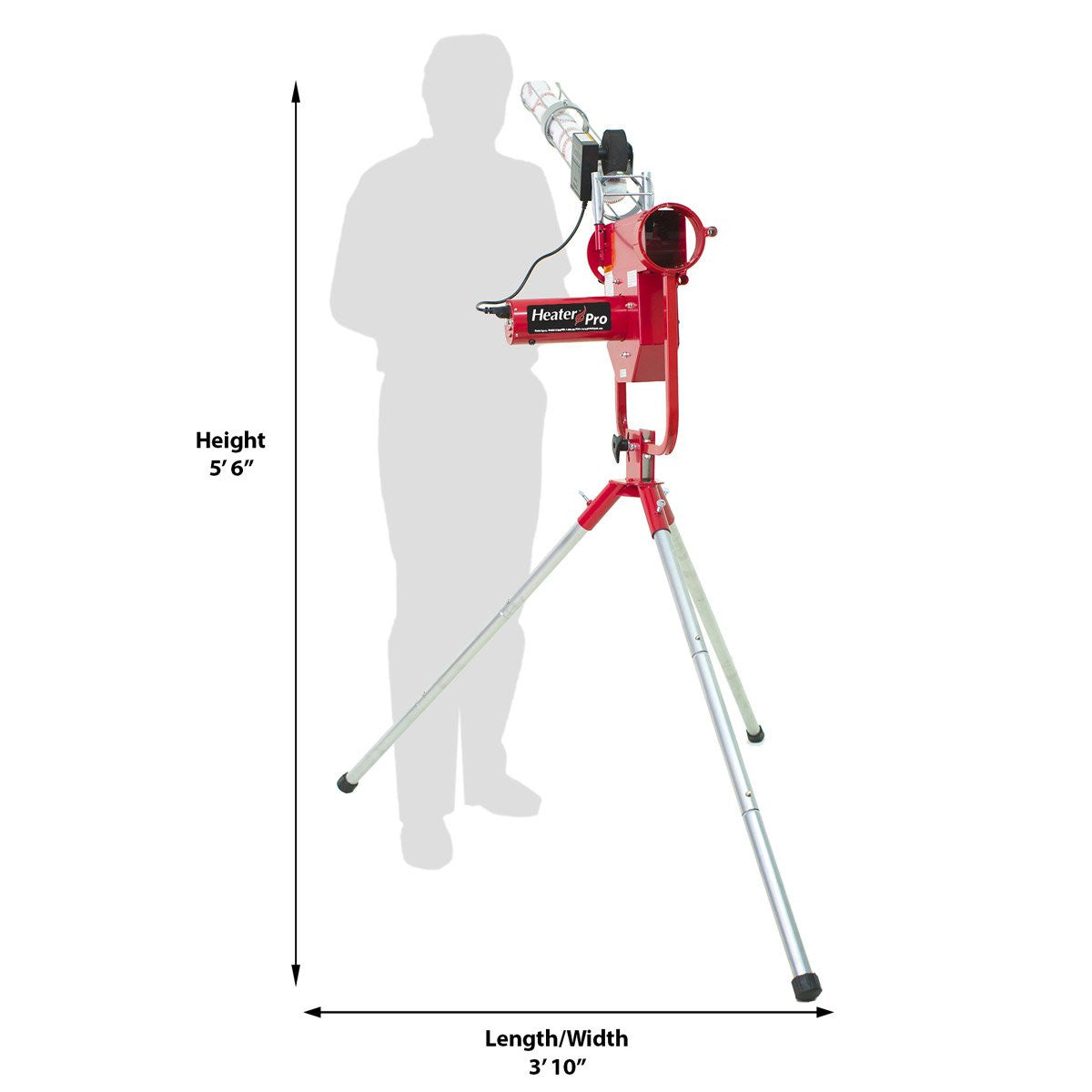
Heater Pro Curve Real Baseball Pitching Machine with Pivot Head and Auto Ball Feeder
The Heater Pro Curve is a single-wheel real-baseball pitching machine with a pivot-head design that throws inside and outside breaking balls in addition to fastballs. It runs at variable speeds up to 52 MPH with real baseballs (up to 80 MPH with lite-baseballs), ships with a bonus 12-ball automatic feeder, and uses the same 1/4 horsepower motor as Heater's other premium machines. At 53 pounds it is the heaviest-duty single-wheel machine in the Heater lineup, aimed at serious youth and high school players who want curveball training without the price or weight of a commercial three-wheel machine.
At $549.99, the Pro Curve sits at the top of Heater's home-use line. For context: it offers real-baseball curveball training in a single-wheel package, a category that most competitors address only with multi-wheel designs priced well above $1,000. The tradeoff is that the pivot-head design approximates breaking-ball rotation rather than producing the precise spin profile of a three-wheel commercial machine. For home batting practice and pitch recognition training, the approximation is close enough to be training-effective.
The Pivot-Head Design Explained
What makes the Pro Curve different from every other real-baseball machine in Heater's lineup is the pivot-head design. The entire pitching housing tilts side-to-side on a vertical axis, not just up-and-down for height adjustment. That lateral tilt changes the angle at which the ball leaves the wheel, which in turn changes the direction and break of the pitch.
Point the pivot-head straight and the machine throws a fastball. Tilt it to one side and the ball leaves the wheel with a sideways component to its spin, which produces a curveball breaking in that direction as it travels to the hitter. Tilt the other way and you get a curveball breaking the opposite direction. Combined with the height adjustment (up-down tilt for pop flies and grounders), the Pro Curve can throw a surprisingly complete pitch variety for a single-wheel machine: fastballs at any height, inside breaking balls, outside breaking balls, pop flies, and grounders.
The break is genuine and hitters have to read it. It is not the three-wheel commercial-machine precision, but for home and team practice it teaches pitch recognition in a way a straight fastball machine cannot. Hitters who train regularly against the Pro Curve get noticeably better at identifying spin and tracking breaking balls, which transfers directly to live at-bats.
Variable Speed: 52 MPH Real / 80 MPH Lite
Pitch speed tops out at 52 MPH with real baseballs and 80 MPH with lite-baseballs. The variable speed dial covers the full range, so a younger hitter training on the same machine can dial back to 30 or 35 MPH for comfortable contact work, then push up as they develop. The 80 MPH lite-ball top end is worth understanding: lite-baseballs at 80 MPH do not feel like a real baseball at 80 MPH because the lighter ball decelerates faster and produces a different perceived pitch speed. But 80 MPH of lite-ball velocity is fast enough to challenge high school hitters on reaction time and timing, particularly when combined with the curveball break.
Heater rates the Pro Curve for ages 8 to adult. For an 8 year old, the meaningful use is dialing the speed way down (30 MPH range) and using the height adjustment without the curveball break. The machine grows with the player: a 10 year old moves up to 35-40 MPH, a 13 year old gets to 45-48 MPH, and a high school hitter uses the top end for timing work and the curveball adjustment for pitch recognition.
12-Ball Bonus Auto-Feeder
The bonus auto-ball feeder included with the Pro Curve holds 12 real baseballs and drops one into the pitching wheel every 10 seconds. That is two minutes of continuous batting practice per full feeder load. The feeder attaches to the top of the machine housing and is easy to remove for storage or manual feeding during instruction sessions where a coach wants to pace pitches differently.
Between feeder loads, reloading is fast and can be done while the hitter takes a short break. For a solo practice session, keep a bucket of balls next to the feeder and plan on reloading every two minutes. For team practices, a coach or assistant can manage the feeder while the hitter focuses on swings.
Heavy-Duty 8-Inch Air-Filled Wheel
The Pro Curve uses an 8-inch air-filled pitching wheel, which is larger than the wheels on Heater's lighter-duty machines. Larger wheel diameter means more surface contact with the ball at release, which translates to more consistent pitches and longer wheel life. The air-filled design cushions the ball on release, which both extends ball life and keeps pitch speed consistent as wheel wear accumulates over thousands of cycles. The wheel is fully enclosed in the composite housing for safety, with only the ball exit opening visible.
Steel Frame and 1/4 HP Motor
At 53 pounds, the Pro Curve is the heaviest machine in the Heater lineup designed for home use. That weight comes from the steel frame and the heavier 1/4 HP motor (same horsepower rating as the Heater Jr., but built into a larger chassis). The weight is an advantage for pitching consistency: a heavier machine is more stable under recoil from each pitch, which keeps the ball trajectory tighter shot after shot. It is a minor disadvantage for portability, but two adults or one strong adult can move it without trouble.
Tubular steel legs with rubber tips anchor the machine on any surface without sliding during use. The rubber tips also protect gym floors or finished surfaces from scratching, which matters if you run the Pro Curve indoors.
Power: A/C Only (or Optional Portable Pack)
The Pro Curve plugs into any standard 110V A/C wall outlet. Heater offers optional Hot Box portable power stations (600 peak and 1200 peak) that take the machine off the grid for field and park practice. The base unit includes only the A/C cord. If your primary use case involves taking the machine to fields, budget for a Hot Box 600 or 1200, the 1200 gives longer run time and better safety headroom for the Pro Curve's heavier motor draw.
Who the Heater Pro Curve Is For
The Pro Curve fits serious youth and high school baseball players who want curveball training at home without the price of a commercial machine. It fits travel teams and high school programs that need a real-baseball curve-capable machine for multi-player practice rotations. It fits adult recreational players working on timing and pitch recognition against breaking balls. And it fits baseball coaches running clinics where a single versatile machine has to cover multiple training scenarios.
It is a considered purchase for families at $549.99. The machines below it in Heater's lineup (the Heater Jr. at $269.99, the BaseHit at $199.99) cover fastball work for youth players at meaningfully lower cost. The Pro Curve's value proposition is specifically the curveball training and the higher top-end speed. If your player is mostly working on contact at 30-45 MPH fastballs, the Heater Jr. is the more economical choice. If they are working on pitch recognition and need to see breaking balls in practice, the Pro Curve is the right tool.
Training Applications
A few drills that make the most of the Pro Curve's pivot-head capability:
Fastball-only rounds. Keep the pivot-head centered and run 10-15 pitches at moderate speed. This establishes timing and lets the hitter focus on swing mechanics without pitch recognition load.
Curveball rounds. Tilt the pivot-head to one side and run 10-15 curveballs. The goal is not to crush every pitch; it is to identify the curve, read the break, and adjust swing path. Miss rate is higher, and that is the point, pitch recognition training requires practice against real breaking movement.
Mixed pitch sequences. Alternate between fastball (centered) and curveball (tilted) rounds, resetting the pivot-head between each pitch or every few pitches. This is the closest approximation to a real at-bat the Pro Curve can produce and is the most valuable drill for game-transfer.
Speed ladder work. Start at 35 MPH, work up 3 MPH per round until you hit the top of a hitter's comfortable timing. Then stay at that speed for 10 swings to cement the new timing. The fine-grained variable speed control makes this drill precise.
Fielding rotations. Use the up-down height adjustment (separate from the pivot-head side tilt) to angle the machine down for grounders and up for pop flies. Run two or three fielders through each.
Using the Pro Curve With a Batting Cage
The Pro Curve is designed to work with Heater Sports home batting cages. The Power Alley 22 foot cage fits typical backyard spaces and is the most common pairing. The Xtender 24 foot (extendable to 72 feet) is the longer option for larger yards, facility use, or situations where you want a full tunnel-length cage. Both cages have pitching machine openings that accept the Pro Curve's housing, so the machine sits outside the cage and pitches in through the opening.
For backyard use without a cage, plan for at least 30 feet of pitching distance and a heavy backstop net behind the hitter. A Pro Curve throwing a line-drive curveball at 50 MPH produces contact that carries a long way off the bat, and you want significant protection behind the hitting zone.
Heater Pro Curve Pitching Machine Specifications
- Model: HTR499BB (includes 12-ball bonus automatic feeder)
- Motor: 1/4 horsepower electric motor
- Pitch speed, real baseballs: up to 52 MPH variable
- Pitch speed, lite-baseballs: up to 80 MPH
- Pitch types: fastballs, curveballs (inside and outside breaking balls), pop flies, grounders
- Pitch mechanism: single-wheel with patented pivot-head design for breaking balls
- Wheel: 8-inch air-filled, fully enclosed
- Ball compatibility: real baseballs (polyurethane pitching machine balls recommended), real leather baseballs, lite-baseballs
- Ball feeder: 12-ball bonus automatic feeder, pitches every 10 seconds
- Frame: tubular steel legs with rubber tips
- Power: standard 110V A/C (cord included) or optional Hot Box 600/1200 portable power pack (sold separately)
- Weight: 53 pounds
- Recommended ages: 8 years to adult
- Compatible cages: Heater Sports Power Alley 22', Xtender 24-72'
What's Included
The Pro Curve ships with the pitching machine housing, the 12-ball bonus automatic feeder, the tubular steel tripod frame with rubber-tipped legs, the A/C power cord, and the printed instruction manual. Heater's polyurethane pitching machine baseballs are sold separately and are the recommended ball for the Pro Curve, plan on at least a dozen or two for meaningful practice sessions. The optional Hot Box portable power pack, a Heater Sports batting cage (Power Alley 22' or Xtender 24-72'), a machine cover, and ball shaggers are sold separately. Real leather baseballs work with the machine but wear faster; Heater machine balls are the economical long-term choice for regular use.
Frequently Asked Questions
How realistic are the curveballs?
The pivot-head design produces a real, visible curveball break. It is not the precision of a three-wheel commercial machine, where each wheel can be individually adjusted to produce specific spin profiles. But for pitch recognition training, the Pro Curve's break is unmistakably a curveball and hitters have to read and adjust to it. For home batting practice and high school team use, the training value is real.
What is the difference between the Pro Curve and the Heater Jr.?
The Heater Jr. (HTR299) is a single-wheel fastball machine at $269.99 covering 15-48 MPH on real baseballs. The Pro Curve (HTR499BB) adds the pivot-head design for curveballs, bumps the top speed to 52 MPH real / 80 MPH lite, uses an 8-inch wheel instead of 6-inch, and weighs 53 lbs vs 23 lbs. The Jr. is the fastball trainer; the Pro Curve is the complete-pitch-variety trainer.
Can my 8 year old use the Pro Curve?
Yes, with the speed dialed down. At 30 MPH with the pivot-head centered (no curve), the Pro Curve is age-appropriate for a developing 8 year old. The more advanced features (curveball work, higher speeds) become relevant as the player develops. It is a machine that can cover many years of player growth, which is part of its value proposition at this price point.
Is it hard to switch between fastball and curveball settings?
No. The pivot-head rotates on its mount with a quick knob adjustment. Most users can switch between fastball-centered, curve-left, curve-right, and back in a few seconds. That makes mid-round pitch variation practical during a single at-bat.
What kind of baseballs should I use?
Heater recommends their polyurethane pitching machine baseballs for the Pro Curve. These are purpose-built for pitching machine use: consistent weight, smooth seams, and a wheel-friendly surface. Real leather baseballs work but wear faster against the air-filled wheel. Synthetic leather is not recommended. Lite-baseballs work and are safer for indoor or backyard use where real balls would risk property damage.
How much space do I need?
Plan for at least 30 feet of pitching distance and 10-15 feet of clear space behind the hitter for a backstop. A full setup including cage typically takes a 12 foot by 35-40 foot footprint in a backyard. Indoor use requires a high school or commercial facility gym, most home basements and garages are too short for meaningful Pro Curve sessions.
Does it work with a Heater batting cage?
Yes. The Pro Curve is designed to pair with the Heater Sports Power Alley 22 foot and Xtender 24-72 foot batting cages. Both cages have pitching machine openings sized for the Pro Curve housing. For full setups, budget for the cage separately, the Power Alley runs about $200 and the Xtender 24 foot runs about $300.
Can I run it off batteries or a generator?
The Pro Curve is designed for 110V A/C power. Heater's optional Hot Box 600 and Hot Box 1200 portable power stations are designed specifically for their machines. A standard quiet generator that provides clean 110V A/C will work, but the heavier motor draw means a smaller generator or inverter may trip under load. If you plan regular off-grid use, the Hot Box 1200 is the safer choice.