


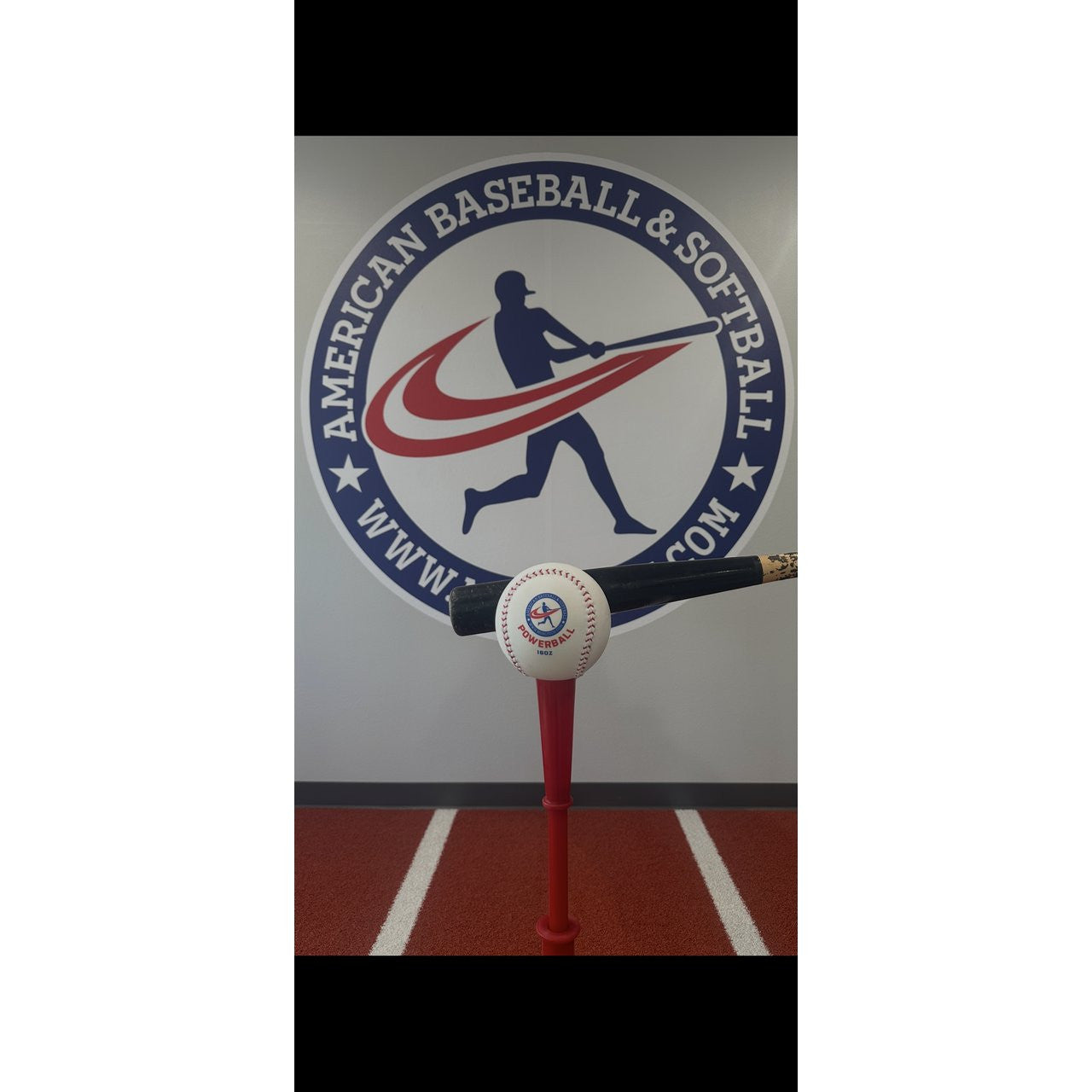
Power Ball 5-Inch Foam Hitting Trainer
The Power Ball 5-Inch Foam Hitting Trainer is built for baseball and softball hitters who want to develop real swing power. Its proprietary foam construction gives the ball a coefficient of restitution under 0.4, so it wraps around the bat on contact rather than rebounding away. Hitters have to drive through the ball with their lower body, core, and hands to move it at all, which forces the exact mechanics coaches spend years trying to teach. Sized for youth through high school players, the 5-inch Power Ball works for tee work, soft toss, and front toss, and it has been adopted by major collegiate softball programs including Texas, LSU, Florida, Arkansas, and Texas A&M.
Soft Foam, Hard Swing
Most weighted or heavy training balls rely on extra mass to make hitters work harder. The Power Ball takes the opposite approach. The ball is soft on contact, but because the foam absorbs and redirects most of the bat's energy, the ball goes almost nowhere unless the swing comes through clean. A half-hearted swing produces a dribbler; a connected swing that fires hips, core, and hands drives the ball across the cage. Baseball and softball hitters get instant feedback on every rep without a coach having to say a word, and the soft impact means players can take 50 or 100 cuts in a session without the wrist and forearm fatigue that comes from pounding heavier weighted training balls.
Built for the Full Kinetic Chain
The whole point of the Power Ball is to make hitters use everything from the ground up. Because the ball does not rebound, arm-only swings and wrist flicks produce nothing. Hitters have to load into the back leg, rotate the hips, keep the core engaged through contact, and extend with the hands to move the ball. Coaches running power-hitting drills for baseball and softball programs know the pattern: a week of Power Ball work is a week of lower-body-driven swings, and the habits carry directly into live baseball and softball rounds. Wrist and forearm strength builds naturally from the work itself, not from a separate exercise.
Safe Impact for High-Rep Power Training
Traditional weighted training balls build power, but they also load the wrists and forearms with every mishit. The Power Ball's foam construction changes the equation. The soft impact absorbs bat recoil and keeps the stress off the hands, so hitters can push into the fatigue zone where real strength gains happen without adding injury risk. Baseball and softball cage managers and hitting coaches appreciate this too. The ball does not chew up netting or dent tees, and it can be used with wood bats, aluminum bats, or a Muhl Tech training bat without a special bat requirement.
Who the 5-Inch Power Ball Is For
The 5-inch Power Ball is sized for youth baseball and softball players through high school. Its 16-ounce weight is noticeable on contact but not so heavy that young players lose their swing form. Travel-team coaches and academy instructors use it as an in-season strength builder because it does not require pulling players off live hitting to train power. Parents running backyard sessions use it the same way. It drops into any equipment bag, works on any tee, and gives a player honest feedback about whether their mechanics are moving the ball or just moving their arms.
Training Applications for the Power Ball 5-Inch Foam Hitting Trainer
The Power Ball is designed to work in the three highest-volume hitting drills: tee work, soft toss, and front toss. On a tee, the ball sits like a regular baseball or softball and teaches the hitter to finish the swing completely, since any short or hand-dominant swing produces no result. In soft toss, thrown underhand from the side, the ball reinforces weight transfer and hip rotation under a moving target. In front toss from behind a screen, the feeder can cycle balls quickly for high-rep power sets where the hitter works to drive ball after ball across the cage. All three drills translate directly to live baseball and softball at-bat mechanics, and most coaches rotate the Power Ball into the same practice blocks they already run with game balls.
Power Ball 5-Inch Foam Hitting Trainer Specifications
- Diameter: 5 inches
- Weight: 16 ounces
- Construction: proprietary foam-filled core
- Coefficient of restitution: under 0.4
- Target audience: youth through high school baseball and softball players
- Approved drill uses: tee work, soft toss, front toss
- Bat compatibility: wood bats, aluminum bats, training bats
- Sold individually (single ball) or as a 3 or 6 pack
- Program endorsements: University of Texas, LSU, Florida, Arkansas, and Texas A&M softball programs
Frequently Asked Questions
Is this ball for baseball or softball?
Both. Power Ball is a baseball and softball training aid, and it is used by both baseball and softball programs at the youth, high school, and collegiate levels. The 5-inch size is well suited to youth-through-high-school players in either sport.
Will it damage my bat or my cage net?
No. The foam is designed to absorb impact rather than transfer it back into the bat, so bat recoil is minimal and wood, aluminum, and training bats all handle it comfortably. The ball will not tear typical cage netting.
How heavy is the 5-inch Power Ball, and is that too much for a young player?
The 5-inch Power Ball weighs 16 ounces, roughly three times a regulation baseball. Because the impact itself is soft, the weight shows up in how much strength the swing has to produce, not as a jolt to the wrists. Coaches have used the 5-inch ball with players as young as 10 without wrist or forearm complaints, but form should always come first.
Can I hit it live off a pitch from a machine or a coach?
The Power Ball is designed for tee work, soft toss, and front toss. It is not designed to be pitched at game speeds or run through a pitching machine. Use it inside the drills it was built for.
How many reps should a session be?
Most coaches cap a dedicated Power Ball block at 30 to 50 swings. The goal is quality connected swings, not volume for its own sake. The ball produces real feedback, and once swing quality drops, the training value drops with it.
Does it work as well with softball bats?
Yes. The ball does not care whether it is being struck by a baseball or softball bat, and the 5-inch size fits standard softball and baseball tees. Softball programs that have adopted it use the same tee, soft toss, and front toss protocols as baseball programs.
