
Heater Sports
Heater Sports Crusher Curve Mini Lite-Ball Pitching Machine
- SKU:
- T04-CR99
- UPC:
- 638280999990
- MPN:
- CR99
- Shipping:
- Free Shipping
- shipping_label:
- free




Description
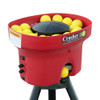
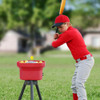
The Heater Crusher Curve is a small-ball pitching machine that throws fastballs and curveballs using mini lite-balls, which are roughly two-thirds the size of a regulation baseball. The idea is deceptively simple: force a hitter to track and hit a ball the size of a golf ball, and by the time they step in against a real baseball, the regulation pitch looks slow and easy. Built around a dual-wheel pitching mechanism and a two-dozen automatic feeder, the Crusher Curve is a focused hand-eye coordination and pitch-recognition trainer for baseball players from about eight years old through adult.
Why Train With Mini Lite-Balls
Elite hitters train their eyes as aggressively as their swings. Small-ball training is a long-established technique for sharpening pitch recognition, tracking, and contact precision. When a hitter consistently makes contact with a ball the size of a large marble or golf ball moving at 40 MPH, the neural habit of picking up spin, reading trajectory, and driving the barrel to the ball transfers directly to regulation baseball pitches. What feels like a normal fastball after a session with the Crusher often feels slow and obvious. Professional and college programs have used variations of small-ball training for decades. The Crusher Curve brings that same concept to a home-use price point.
Mini lite-balls also solve a practical problem: space. A full-sized pitching machine firing real baseballs needs a batting cage, a big backyard, or a gym with a net. Mini lite-balls are soft and travel shorter distances, so the Crusher works in a garage, basement, driveway, or smaller backyard without worrying about broken windows or dented siding. The confined training space is its own benefit; many hitters find short-throw work easier to focus on because there is less visual distraction than a full hitting tunnel.
Dual Wheel Means Real Curveballs
The Crusher Curve uses a dual-wheel pitching mechanism, which is the key hardware difference between this machine and Heater's single-wheel units. With two independently controlled wheels, the machine can impart real rotation on the ball rather than just pushing it forward. Set both wheel speeds equal and the machine throws a straight fastball. Speed one wheel up and slow the other down, and the mini ball leaves the machine with curveball rotation, breaking sideways or downward as it travels.
That is the same principle commercial three-wheel machines use to throw sliders, changeups, and curves. On a mini-ball scale it is surprisingly effective because the small ball size exaggerates the visible break. A hitter sees a clearly curving pitch and has to adjust swing path and timing accordingly. For pitch recognition training, curveball work with the Crusher is its standout feature.
Variable Speed Up to 40 MPH
Both wheels feature variable speed control, with a top end of approximately 40 MPH measured at 25 feet from the machine. That number matters for two reasons. First, 40 MPH of mini-ball velocity produces perceived pitch speeds well above 40 MPH because the smaller ball and shorter distance compress the reaction window. Hitters routinely describe the Crusher as feeling like mid-60s or higher real-baseball pitching in terms of reaction time. Second, the variable speed dials let you back off for younger hitters. A seven or eight year old just starting small-ball work will benefit from a slower setting that lets them build confidence before moving to the top end.
Two-Dozen Ball Feeder With Adjustable Timing
The Crusher's automatic feeder holds 24 mini lite-balls and drops them into the machine at a user-controlled pace. A timing knob adjusts the interval between pitches from about three seconds to about twenty seconds. That range is more useful than it sounds. Three seconds is aggressive rapid-fire training for reaction time and swing recovery. Twenty seconds gives a hitter time to step out, reset, and approach each pitch deliberately. Most coaches settle somewhere in the middle for general BP, closer to eight or nine seconds, which matches a typical real-game pace between pitches.
A full 24-ball load empties in anywhere from 75 seconds at the fastest setting to eight minutes at the slowest. Refilling is fast because the feeder is open-topped.
Adjustable Height for Different Pitch Types
The Crusher Curve's pitching housing adjusts up and down on the steel leg frame. Point it level for normal strike-zone work, angle it slightly up for high pitches or fly-ball hitting, or tilt it down for low strikes and ground ball practice. Combined with the dual-wheel curveball adjustment and the speed dial, the height setting lets you build a practice session that mixes pitch locations and pitch types, which is closer to what a real at-bat looks like than a single-pitch machine can offer.
Safety and Indoor Use
The wheels are fully enclosed in the composite housing. That is essential on a machine used by kids at close range, because open wheels pose a real pinch hazard when you are loading balls. Combined with the soft mini lite-balls (which are foam or soft polyurethane and cannot break windows or seriously injure someone at Crusher speeds), the machine is safe for indoor use. Garage setups and basement training stations are both practical. Ricochet off the bat can still sting if it hits you, and good practice is to always use a protective screen or net behind the hitter, but the property-damage risk that rules out real-baseball machines indoors is largely gone with the Crusher.
Power: Plug or Battery
The Crusher Curve runs on standard 110V A/C power using the included cord. Heater Sports also offers optional rechargeable batteries (4-hour and 8-hour packs) that replace the A/C cord for portable use. With a battery pack, the machine travels to a park, a field, or a tournament warm-up area where power is not available. The base Crusher Curve unit (model CR99) ships with the A/C cord and a battery compartment ready for the optional battery pack. If you expect to use the machine away from outlets, budget for the battery separately.
Who the Crusher Curve Is For
The Crusher Curve fits a more specific audience than a general-purpose pitching machine. It is best for baseball players ages eight through adult who already have basic swing mechanics down and want a training tool for pitch recognition, curveball tracking, and hand-eye sharpening. Little Leaguers in the 9U to 13U age range get the biggest developmental jump, because that is where pitch recognition becomes the limiting factor in their hitting. High school players use the Crusher for warm-up work and for sharpening eyes before games. College players and adult recreational players sometimes use it in the off-season for the same reasons.
The Crusher Curve is less useful for very young players still learning to track a ball at all (a slower, larger-ball machine like the Heater BaseHit is a better starting point) and for players who already get high-quality curveball work from a live pitcher or commercial three-wheel machine. It is also not a batting cage substitute; it is a supplement to cage work, a focused hand-eye coordination drill, and a way to put in baseball reps without tying up a field.
Training Drills for the Crusher Curve
A few drills that make the most of the Crusher's dual-wheel capability:
Fastball-only tracking. Set both wheels equal and run a 24-ball round at moderate speed. Focus on contact, not power. This is the baseline drill that teaches the hitter to track the mini-ball size.
Curveball recognition. Set the wheels for a clear curveball break and run a 24-ball round at moderate speed. The goal is not to hit every pitch hard; it is to correctly identify the pitch as a curve and either take it or adjust the swing. Miss rate is high early, and that is fine.
Mixed pitch sessions. Alternate fastball and curveball rounds with a short reset in between to flip wheel settings. Track which pitch type the hitter identifies correctly. This drill builds in-game pitch recognition faster than either pitch alone.
Timing ladder. Start at the slowest feeder interval (about twenty seconds) and work down toward the fastest (about three seconds) over a single round. Each pitch comes faster than the last, which trains swing recovery and mental reset under time pressure.
Rapid-fire fastballs. Set the feeder to its fastest interval and top the speed dial out. This is a reaction-time drill that intentionally overloads the hitter so that game-speed real baseball pitches feel comfortable by comparison.
Heater Crusher Curve Specifications
- Model: CR99
- Pitching speed: up to 40 MPH at 25 feet
- Pitch types: fastballs and curveballs (dual-wheel mechanism)
- Ball type: mini lite-balls, approximately two-thirds smaller than a regulation baseball
- Ball feeder: 24-ball automatic feeder with adjustable pitch interval from about 3 to 20 seconds
- Wheels: dual-wheel with variable speed controls, fully enclosed for safety
- Frame: tubular steel legs with rubber tips
- Pitch height: adjustable
- Power: standard 110V A/C (cord included) or optional rechargeable battery pack, 4-hour or 8-hour, sold separately
- Weight: 10.6 pounds
- Packed dimensions: 10.5 x 9 x 18.75 inches
- Recommended ages: 8 years to adult
What's Included
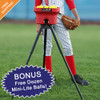
The Crusher Curve ships with the pitching machine, a built-in 24-ball automatic feeder, one dozen Crusher mini lite-balls to get started, the A/C power cord, the battery compartment ready for an optional battery pack, and tubular steel legs with rubber tips. Additional mini lite-balls are sold separately in packs (Heater's standard mini poly-balls and slow mini-lite balls are both compatible). The rechargeable battery packs and any expansion accessories like batting cages are also sold separately. No baseballs are included because the machine is designed exclusively for mini lite-balls, not regulation baseballs.
Frequently Asked Questions
Will this machine throw real baseballs?
No. The Crusher Curve is built specifically for mini lite-balls (golf-ball-sized soft training balls). Feeding it a regulation baseball would damage the machine. If you want a Heater Sports machine that throws real baseballs, look at the BaseHit (fastballs only) or the Pro Curve (real-ball dual-wheel machine).
How realistic is the curveball?
Surprisingly realistic in terms of visible break and in terms of training value for pitch recognition. The ball is smaller than a real baseball, so the physics is not identical to a pro curveball, but the dual-wheel spin produces clear lateral and vertical break that a hitter has to read. For its price point, the Crusher Curve delivers the most accessible home curveball training available.
Can I use it in my garage?
Yes, with reasonable precautions. The mini lite-balls are soft and unlikely to cause damage at Crusher speeds. Set the machine at one end of the garage, hitter at the other, and use a backstop or piece of carpet to catch balls that get past the hitter. The enclosed wheels and light ball weight make garage use one of the Crusher's main use cases.
What age is this appropriate for?
Heater Sports recommends ages 8 to adult. Below 8, pitch recognition training with mini balls is usually beyond what the hitter needs and can be frustrating. Above 8, benefit varies by skill level; recreational youth players use it as a pitch recognition trainer, while older players use it for timing and warm-up work.
Does the rechargeable battery pack come with it?
No. The CR99 base unit includes only the A/C power cord. Rechargeable battery packs (4-hour and 8-hour capacity) are sold separately. The machine has a battery compartment built in and ready for the optional pack. If you plan to use the Crusher away from electrical outlets, add the battery pack to your order.
How many balls do I need to buy with the machine?
The Crusher Curve ships with one dozen mini lite-balls. The feeder holds 24, so one additional dozen brings you to a full feeder load. Most users eventually build up to two or three dozen total, which lets them run longer sessions without stopping to collect balls. Heater sells both their fast mini poly-balls and slow mini-lite balls; both work with the machine, with the slow balls being a bit easier on the machine and on surrounding surfaces.